Tuesday, January 31, 2006

In Memory of Dawn Wiener


I watched Todd Solondz's (does anyone know how to pronounce his name? I think it's sa-lanz (soft "a", long "a" and a soft 'z") film Palindromes last night. I had read and heard enough about the film to know that he employed multiple actresses for the main character (Aviva), and from what friends who had seen the movie within the past two weeks had said, I knew the basic premise. Aviva is a young Jewish girl -12ish- who desperately wants to become pregnant in order to love someone unconditionally. In her premature pursuit of this goal, she gets mixed up in sex with a family friend (Judah), and man in his late 30's, early 40's (Earl).

I approached this movie wary of Solondz's slap-in-the-face preoccupation with all things squeamish, and wanted to see this movie because:
1. I'm interested in the way that he is approaching storytelling in his most recent movies (Storytelling is, incidentally the name of his film that preceded Palindromes).
2. I find watching films on a television severely disappointing but figured there was probably enough for me to think about (around) this film that watching it on one would not put me to sleep.
3. I love palindromes, my favorite being "Go hang a salami I'm a lasagna hog".
4. I love to watch a film after people tell me about it- I love to see what they've seen, knowing what they reacted positively and negatively to. I also like watch a film that other's have described to me and note what they opted to edit out of their review. I find this instructional of the friend.
5. Welcome To The Dollhouse is an amazing movie.

With those five reasons in mind, I was pretty disappointed with the content but not the form of the film. Solondz's choice of subject matter- abortion, child sexuality, pedophilia, fundamentalist liberalism and Christianity- makes for an explosive and challenging movie. And although I respect and admire his ability to challenge and frustrate viewers (talk about "bravery"- in a battle between Solondz and Ang Lee, Lee's big budget butt would be whooped) but Solondz's machinations have become cliche, and his use of multiple actors was lost within the conceptual confusion that resulted from his trying to fuse so many incendiary topics into one film.

However -and much to Solondz's credit- it is no small feat to ask your viewer to accept the main character of a film to be played by multiple actors throughout a film and he deals with this well. He broke the movie up into chapters causing the viewer, after a few of them, to expect that with each new chapter we get a new actor. This reminded me of Lars Von Trier's Dogville. Dogville, also divided into chapters, took a different path with Von Trier laying out precisely what would be coming up in the next chapter in order to undermine the viewers tendency to get lost in the tropes of film. Both Palindromes and Dogville, share an affinity to Fellini's 81/2 by addressing the film within the film(is "meta-film" a word?). I find this exciting- most filmmakers can't make me suspend my judgment long enough that I simply watch their film- and despite the shortcomings of the subject matter the activity of watching Palindromes was worth the hour and a half of my time.

Two things were left out of my friends' reviews that I think are essential to the film: One being that the movie begins with the words "In Memory of Dawn Wiener". Dawn is the hapless geek protagonist of Solondz's film Welcome to the Dollhouse, and her death casts a shadow over the entirety of Plaindromes. Dawn's death is also, by and large, the reason that Aviva wants so badly to be pregnant. So again, the layers of meta-film build...and makes me think of years ago when I would read novels by Tom Robbins and be so happy to be back in the presence of an author who, as he guided me with his words, always made it plain that what he was doing was writing.

Second (and this is it for writing about this movie), my reviewing friends made no mention of Solondz's characterization of the Jewish men in the film. The characters are, in essence, character-less, and all but the abortionst are geeky, unattractive, and spineless. The ultimate example is Aviva's father who sits by dumbly and allows his wife to force their daughter to have an abortion (all the while the look on his face making you realize how easy it is to destroy a person's life). I trust that this was intentional on Solondz's part. If nothing else, he does move forward with great intention. What it means? I'm really not sure.

Interview with Solondz

Monday, January 30, 2006

The Second Obstruction

This is a house on Beall's Lane in Frostburg, Maryland. It's a few doors down from Kim's mom's house and it's always for sale (my guess is that the utilities are so expensive that most people in the area don't have jobs that pay enough to maintain it). The house is wood, has two big porches, a great sunroom, and all of the original woodwork throughout the house appears to be intact. It also has a beautiful yard and nice outbuildings. One night, when Kim and I were just beginning to spend time together, we laid down under the Black Walnut tree in the backyard and talked. This was the night that Kim told me about having to have an operation for scoliosis when she was in the 8th grade.

When I visited Frostburg over the holidays, I parked in front of the house and the first thing I did when I got out was take this picture.


Tuesday, January 24, 2006

The First Obstruction

In DC a few months ago, at a Gay Owned hamburger joint where the bill was delivered in a used woman's' shoe, Kim thwarted my efforts to channel William Eggleston:


Monday, January 23, 2006

Superstars Clowning and Krumping


Kim and I watched David LaChapelle's documentary Rize last night. For those who haven't seen or heard of it, Rize it is concerned with Clowning and Krumping- two types of dancing borne out of South Central Los Angeles, and specifically a response by one dancer (Tommy the Clown) to the Rodney King riots of 1992.

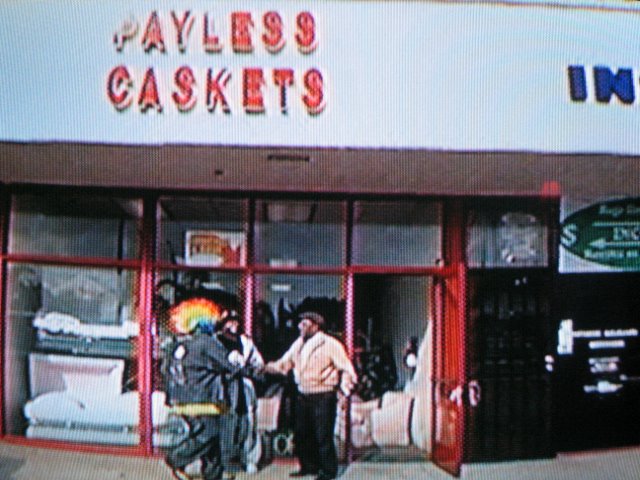
If you saw any of the previews, or read the article in the New York Times Magazine last summer, you get the idea of what the documentary is all about: Kids with nothing to look forward to, opting to dance at birthday parties, and competitions in lieu of joining one of the ubiquitous gangs in the area. The reality of premature and violent death is so prevalent in these kids' world that a local strip mall houses Payless Caskets- a cut-rate casket showroom with the signage of a dollar store. The owner glibly tells one of the kids to make sure that his parents know where Payless Caskets is located in case/when they need a coffin for their son. In spite, or maybe as a result of such palpable death, the kids create their own alternate existence through their dancing. They do this dancing daily, and it evolves at a such a rapid pace that the dancers claim to be able to detect if someone hasn't danced for even one day.

The dancing is nothing less than wild. With their rapid-fire-twitching-hips, convulsing torsos, flailing arms, these kids look as though they could be handling serpents and drinking strychnine in some LA shrine- one tucked into a sprawling and unmistakably, LA spillway . LaChapelle does these kids a favor and makes them super-saturated superstars of their small, dangerous world.

LaChapelle asserts the dances' influences by including archived footage from the two riots that have come to define life in South Central LA (Watts Riots of '65 and the King Riots of '92), as well as images of African dancers preparing for, and participating in traditional dance ceremonies. These ceremonies show the African dancers moving in ways not dissimilar to the kids in LA. I can imagine that his inclusion of the images from Africa caused consternation for some - LaChapelle does not frame the inclusion of the images with dialogue from an anthropologist, or other specialist, but instead goes out on a limb and assumes that in 2005 we, as a "First World" culture, fat from consuming thousands of sophisticated images daily, can make the leap with him and understand how kids could go from being exposed to African heritage, to assimilating aspects of that culture into their own. I think this is the subtle grace of the film- we don't need a specialist to tell us that people learn from seeing. Everyone, and everything we know is living proof that we are a sum of our parts. We are mash-ups of every image, sound, taste, and touch that we consume.

Saturday, January 21, 2006

Life Without a Tail


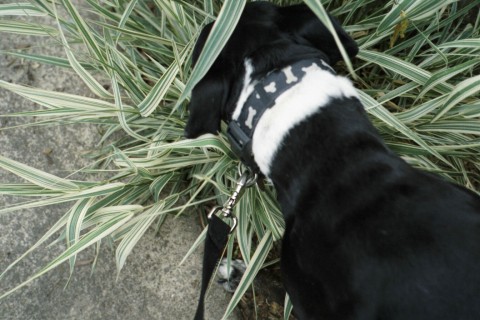
It has been over 10 months since I buried Annabelle. Increasingly, what I miss is seeing her tail - from above- wag as we walked down the sidewalk. We walked three times a day- she'd sniff the traces of the other neighborhood beasts, and I'd sniff too. I'd playfully squeeze the skin above her back hips- signaling that I wanted to play- and she'd run ahead a bit, benignly throwing her head back and acting as though she wanted to nip my fingers. On Grove Avenue, she got into the habit of running the last half block of our walk. She'd sprint ahead of me - stopping a house before ours- and look back to make sure I was following and that it was okay for her to continue. And when she saw that I was, and that she could, she'd dart the rest of the way, bound up the steps, turn around, and wait for me to open the door. How automatic it was that I pet her jowls, and called her "the nose" as I ascended the stairs, thinking about the day that lay ahead of me.

Walking is lonely (and quiet) these days. Kim, Todd, and I walk together- but it's different. I talked and listened to Annabelle in ways that I've never done with anyone else.

Friday, January 20, 2006

New Direction

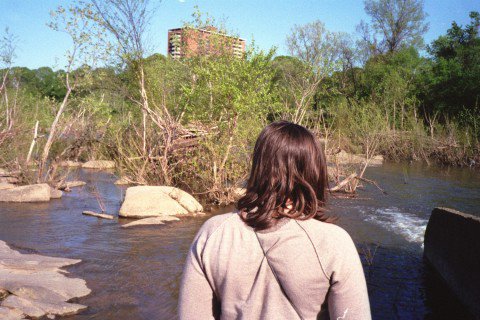
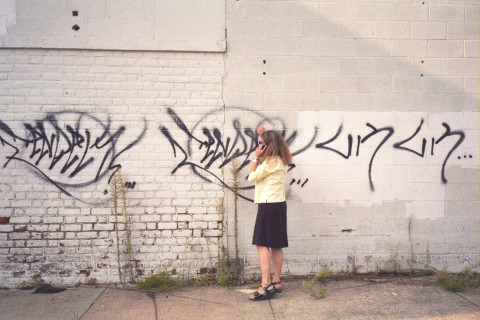
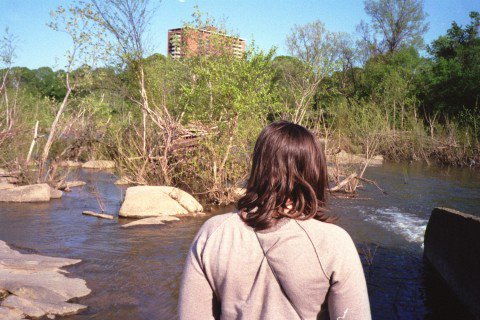
I routinely sift through my negatives, and am pleasantly surprised by recurring themes that I'm not fully aware of. By the looks of it, I can't seem to stop taking pictures of women when they are not looking at me.


Thursday, January 05, 2006

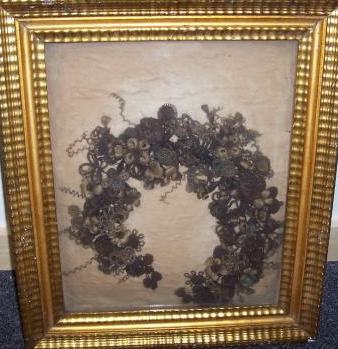
Memorials of Hair

When I was first in college and had a lot of time (and a lot of hair), I used to take the hair out of my hairbrush and make bracelets for my friends. I don't have that kind of time, (or hair) these days, but memorial hair wreaths and jewelry pops up in my mind or in conversation with a pretty regular frequency. It's pretty interesting and this quote makes it clear why I'm writing this:

Hair was valued for sentimental reasons at a time when there were no photographs. In lieu of photographs, young girls kept scrapbooks of their schoolmate's hair, usually with a name and verse to go with it identifying whose hair it was.
Here's a little bit of the history of made-with-hair mourning jewelry from www.victorianhairartists.com :

Jewelry made with hair is dated back to at least the 1600's, when hair bracelets were given as love tokens by both men and women. During this time one was likely to find the hair placed under glass and used as a background for initials or some other personal symbol to the wearer. Hair jewelry stayed popular until the late 1800's. Many people today believe that hair jewelry was made only for the purpose of remembering a deceased loved one. While that was one function of hair jewelry, many pieces were also made for sentimental reasons, as tokens of affection.

Queen Victoria gave pieces of jewelry made from her hair as gifts, many of these pieces were given to her children and grandchildren. Napoleon wore his watch on a chain made from the hair of his wife, Empress, Marie Louise.

There is even a museum and I bet it's worth checking out. It's in Missouri:
Leila Cohoon 's Hair Museum 1333 South Noland Road Independence, MO 64055
(816) 833-2955

I once went to the Polka Hall of Fame in Cleveland- it was great.

Monday, December 12, 2005

Not Soft Totalitarianism


December 12, 2005

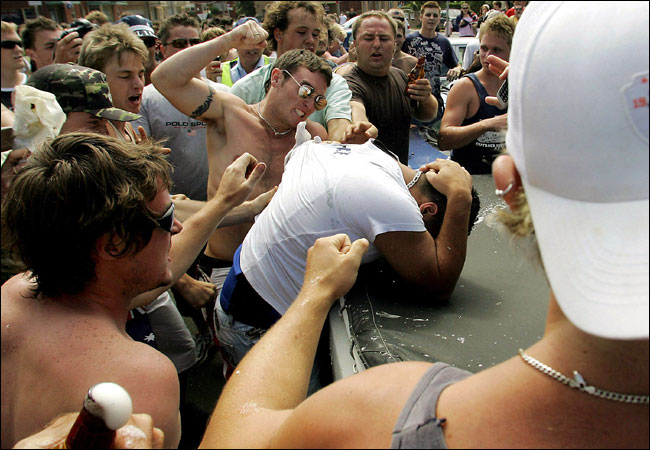
Racial Violence Continues in Australia

Filed at 4:34 p.m. ET

SYDNEY, Australia (AP) -- Violence spilled into a second night Monday as scores of youths drove through predominantly white suburbs of Sydney, smashing windows of cars, homes and stores and raising fears of spreading racial unrest.

Prime Minister John Howard called the violence ''sickening,'' but denied it was rooted in racism. Arab community leaders said the unrest would heighten racial tensions as cell phone text messages warned of retribution by the Arab community and attacks by neo-Nazi groups.

About 5,000 white men, many of them drunk, targeted people believed to be of Arab or Middle Eastern descent on Cronulla Beach on Sunday after rumors spread that Lebanese youths assaults two lifeguards earlier this month.

Police, who had stepped up patrols on the beach after learning of cell phone text messages urging people to retaliate for the attack on the lifeguards, fought back with batons and pepper spray.

Young men of Arab descent struck back in several Sydney suburbs Sunday, fighting with police for hours and smashing dozens of cars with sticks and bats, police said. They said 31 people were injured, including a white man who was allegedly stabbed in the back, and 16 arrested.

Carloads of youths also tore through the suburbs Monday night, attacking vehicles and throwing bottles through windows. While only one person was reported injured and six arrested, there appeared to be more damage to cars and stores than on Sunday.

Television images of Sunday's riot shocked Australians, who pride themselves on tolerance and credit an influx of immigrants with helping build up the country after World War II.

Tensions between youths of Arabic and Middle Eastern descent and white Australians have been rising in recent years, fueled by the Sept. 11 attacks in the United States and deadly bombings on Bali that killed 202 people, including 88 Australians.

Many Muslims also were angered over Howard's decision to contribute troops to the U.S.-led invasion of Iraq in 2003.

The president of the Islamic Friendship Association of Australia, Keysar Trad, said the violence was ''bound to happen'' following angry calls to radio talk shows after the attack on the lifeguards. Police have denied the assault on the lifeguards was racially motivated.

The unrest recalled three weeks of rioting in France that began in the suburbs of Paris on Oct. 27 and spread nationwide, baring frustration in communities with high immigrant and Muslim populations.

Police spokesman Paul Bugden said he did not have descriptions of those involved in Monday night's rampage, but said it was linked to Sunday's rioting.

Witnesses told an Associated Press photographer that some youths involved in the attacks were Middle Eastern or Arabic in appearance and others wore ski masks. Australian Broadcasting Corp. reported that police said men of Middle Eastern appearance were involved.

New text messages calling for more violence reportedly were being circulated. ''We'll show them!'' one message said, according to The Australia newspaper.

Howard defended Australia's policy of tolerance, noting that the nation has successfully absorbed millions of foreigners. ''I do not accept that there is underlying racism in this country,'' he said.

His comments were clearly aimed at immigrants and their families. Howard repeatedly has come under criticism for refusing to apologize for past government abuses of Aborigines, Australia's poorest and least educated minority group.

Morris Iemma, premier of New South Wales state, said police would find those behind the violence. ''Let's be very clear, the police will be unrelenting in their fight against these thugs and hooligans,'' he said.

About 300 people of Arab descent demonstrated against Sunday's attack outside one of Sydney's largest mosques, amid tight security.

''Arab Australians have had to cope with vilification, racism, abuse and fear of a racial backlash for a number of years, but these riots will take that fear to a new level,'' said Roland Jabbour, chairman of the Australian Arabic Council.

In the 2001 census, nearly a quarter of Australia's 20 million people said they were born overseas. The country has about 300,000 Muslims, most in lower income suburbs of large cities.

A resident of the predominantly white suburb of Brighton-Le-Sands, Steven Dawson, said a bottle thrown through his apartment window Monday showered his 5-month-old son with glass, but did not hurt the boy.

Horst Dreizner said a car was rammed through the front doors of his denture store. ''Personally, I think it is only the beginning,'' he said by telephone.

The violence distressed residents of Sydney.

''What we have seen yesterday is something I thought I would never see in Australia,'' Community Relations Commission chairman Stepan Kerkyasharian told Sky News.

Religious leaders urged calm, with Roman Catholic Archbishop Cardinal George Pell urging people to ''reject the extremists in both camps and work together so that this is the end of major disturbances, not the beginning of something worse.''

Saturday, December 10, 2005

Installment 1: A series of Unlikely Vignettes

Installment One: A Series of Unlikely Vignettes

What follows here is first in a series of installments which, when complete, will be the entirety of the thesis I wrote for an MFA in Photo and Film at Virginia Commonwealth University. The title of the thesis (think of it instead as a hefty magazine article and it could possibly be tolerable) is Posthumous- which was also the title of the exhibit that I had at the end of grad school- it is pages and pages long and was required in order to complete the degree. Fear not, an exhaustive description of Posthumous is down the road, but first, there has to be some background. This first installment is titled "A Series of Unlikely Vignettes" and it relates... well you'll see what it relates...


Disclaimer: Remember that this is the result of two years of grad school (there is a perverse thrill to "publishing" my thesis as a Blog). Sorry too for any weird glitches that resulted from copying and pasting.


I grew up in Marlton, Marlton is a suburb of Upper Marlboro, Maryland. Upper Marlboro, Maryland is a suburb of Washington, D.C.

For the first 18 years of my life I lived less than 10 miles from Thacker Caskets Inc. Thacker Caskets Inc. is located on Alexander Ferry Road in Clinton, Maryland, and I passed the business a few times a week as the road is one of only three ways out of Marlton.

I moved to Richmond after having lived for 10 years in Frostburg, Maryland. As excited as I was, to be in an environment that looked (and felt) like the one I had been raised in, it also felt like a sort of homecoming to find that Thacker Caskets Inc. has a manufacturing plant on Marshall Street in Carver.

During the seventh grade in Mrs. LaFaive's Social Studies class, we were required to take a standardized, projected-career-placement test. I answered the 100 plus questions and when the results were returned the final week, it was suggested -based on the bubbles I had darkened with my number 2 pencil- that the careers which best suited my personality were: undertaker, truck driver and mailman.

During my Pop's funeral my mother -whom I did not recognize that day because she was both younger and older than I had ever seen her- fainted while a tenor sang Ave Maria.

Marlton is only 9 miles from Clinton, MD where the Mary Surratt House Museum is located on Brandywine Road. Mary Surratt, a coconspirator with John Wilkes Booth in the assassination of Abraham Lincoln, was the first woman to be executed by the United States Government. Often when family would visit from out-of-town we would tour the museum. Among the artifacts on display was a vitrine containing two photographs taken by Alexander Gardner before and after Surratt's execution. The first photograph shows she and the three others indicted in Lincoln's execution just prior to the release of the gallows' trap door. The second shows the four bodies hanging while the crowd disperses.

Every Sunday I call my Nana and we talk on the phone. When my Pop was still alive they'd joke about jumping off the balcony of their 6th floor apartment in Alexandria, Virginia. Now that my Pop has been dead for almost two years, Nana, at 92, still occasionally jokes around about jumping, but more often than not, her talk of dying is more serious. I think that I am the only person that my grandparents ever spoke to this way.

Living just a short drive from Washington DC, on weekends, my family would often visit the National Zoo. My favorite animals to visit were the seals- I could view them from above or below the water's surface- they were often active, and they were always black and shiny. Along the perimeter of their pen was a fence, along the fence were plaques, and on the plaques were color pictures warning of the dangers of throwing pennies into the water the seals swam in. The pictures showed the hot-pink stomach of an autopsied seal full of shiny, bright pennies.

When I was 17, one of my childhood best friends died in a 42-car pile up on a California freeway. In order for his family to have his casket open during his wake, his face had to be reconstructed. His nose looked like putty and when, through tears I looked at him, all I could think was how he did not look like the pictures that I had of him.

In 1986 I was in the 8th grade- Middle School- and was in the midst of what were (hopefully) the most awful years of my life. Had I been a girl, I could have been the luckless geek Dawn Weiner in Todd Solodnz' Welcome to the Dollhouse. On January 28 my science teacher wheeled a television into the classroom, and turned off the fluorescents so that we could watch the Space Shuttle Challenger lift off from Cape Canaveral, FL. On board the Challenger was an astronaut named Christa McAuliffe; a Social Studies teacher from Concord High School in Concord, New Hampshire, McAuliffe was to be the first civilian to go into outer space. Her inclusion in the mission was swathed in a media frenzy praising NASA and the Reagan administration's decision to allow someone so ordinary to do something so extraordinary. 73 seconds after take off, while looking at the screen and thinking how amazing the exhaust from the Shuttle engines looked against the blue sky, the Space Shuttle Challenger exploded. A week after the explosion, I heard this joke:

Q: Did you know that Christa McAuliffe had dandruff?
A: They found her Head and Shoulders.

During the two years that I attended Catholic school, whenever a siren was heard we were required to pray for the safety of those for whom the siren wailed.

In 1971 my father bought nine of the seventeen volumes of Time Life Books Life Library of Photography. I perused the clothbound, silver and black books for years looking at pictures of places that were proof of a life other than the one I knew, and searching for prurient content for masturbating. One volume, titled The Art of Photography featured Adam and Eve, a sequence of images by Duane Michals that
showed a transparent man approaching, and eventually touching, the breast of a sleeping, nude woman. A few pages away, was another sequence by Michals:
Death Comes to the Old Lady.

For four months I was my Pop's primary caregiver while my Nana recovered from an operation for adhesions in her small intestine. I spent long days with him sitting in his off-white bedroom while he would hold my hand and tell me how badly he wanted to die. Whenever I visited my Pop before he died I always told him that if he felt like it was time to go that he should do so, and not feel guilty. I would say that 94 years was a long time, and that everyone would understand. Before leaving his room, I would lean down and he would hold my face and kiss me at least six times as I pressed my face against his.

On April 5, 2005 I buried my 12 year-old dog Annabelle in my parents' backyard in Marlton. She had been paralyzed from a fall down their stairs, and when the veterinarian administered the lethal injection I held her. I timed my breathing with hers, smelled her fur, told her I loved her, and felt her body change. I think I can still feel the sensation of her lungs deflating- of her entire body going slack. Her funeral was the first at which I was finally able to take pictures.

Installment 2: The Dead People in my Paper: Obit to Self: April 10, 2005

What follows here is the second of two installments which, when complete, will be the entirety of the thesis I wrote for an MFA in Photo and Film at Virginia Commonwealth University. The title of the thesis (think of it instead as a hefty magazine article and it could possibly be tolerable) is Posthumous- which was also the title of the exhibit that I had at the end of grad school- it is pages and pages long and was required in order to complete the degree. Fear not, an exhaustive description of Posthumous is down the road, but first, there has to be some background. This installment is titled "The Dead People in My paper: Obit to Self: April 10, 2005 and it relates... well you'll see what it relates...


Disclaimer: Remember that this is the result of two years of grad school (there is a perverse thrill to "publishing" my thesis as a blog). Images will be posted asap.


The Dead People in my Paper: Obit to Self: April 10, 2005

Only that which narrates can make us understand.
-Susan Sontag

Two months ago I watched the film Hotel Rwanda and was infuriated. I wasn’t angered
by the film itself, but by the idea that the lives of 800,000 people, and the history of three
months of genocide, had been compressed into a one hour and fifty minute movie. That
Hotel Rwanda could potentially be viewed as a sort of definitive representation of the
Rwandan crisis during 1994 is problematic. If I accept that media such as movies,
television and newspapers are (in part) eligible to relay to me the social history of the
world, I feel I must ask these questions: What did the director of Hotel Rwanda, Terry
George, leave out? What parts of the “story” of Rwanda did he augment in order to make
a dynamic film? What, specifically, did Terry George want me to remember about what
happened in Rwanda? What kinds of decisions were made to appease the financial
supporters of the film? What am I “left with” –in terms of understanding the situation after
watching this movie? Unfortunately, what I was “left with” was an impotent message of Hope. Not to deride the many works of art whose message is similar, but, is Hope enough to ask for in the face of 800,000 murdered people? And, are the conventions of the motion picture –its filmic clichés- like sweeping, gestural camera movements, professional actors, use of archetypical myths (Don Cheadle as Luke Skywalker?), a string section, a conventional, linear narrative structure, mega million dollar production and marketing- the best way to address the horror of the genocide in Rwanda? After watching the movie, I left the theatre despondent and thinking that in the near future there could be a section in video stores titled: “Human Atrocities”. On the
shelves in this section could be the slim cases holding pale evidence of what negligently gets passed as history: The Killing Fields; Cry Freedom; Romero; In the Name of the Father; The Magdalene Sisters; Schindler’s List; Johnny Got His Gun; Land and Freedom; Missing…

Photography implies that we know about the world if we accept it as the camera records it. But this is the opposite of understanding, which starts from not accepting the world as it looks. All possibility of understanding is rooted in the ability to say no.
–Susan Sontag

Similar to movies about atrocities, photographs that depict the “human condition” (war, disease, death, famine…) rely on the concept of simplifying (compressing) information in order to deliver efficient, palatable, and ultimately marketable stories. These stories allow the viewer the illusion of feeling informed and empathetic, while remaining free of being implicated in the events they depict. Photography, a medium whose ubiquity we are forever subject to, is plagued by problems. One problem is the weight of photography as a representational medium. As Roland Barthes wrote, photographs are an “emanation of the referent”. This emanation gives the photograph the power to convince its viewer that its ability to represent its subject- in a convincing likeness- implies an understanding of its subject. This ability to represent with the camera- to bear witness, to document, to show- has carried with it a sense of responsibility that has left the history of the medium peopled with liberal photographers. These photographers hope that their images not only attest to what it is “happening” outside of our homes- they strive for their images to affect positive change in the situations they depict. This sense of responsibility to the referent is photography’s weight. Although these aspirations may be asking a lot of the medium, the seeming naiveté of these photographers should not be derided. Larry Burrows’ photographs from Vietnam, and more recently, the images from the Abu Ghraib prison, taken by soldiers participating in the abuse of Iraqi prisoners, became catalysts for action
against the situations they documented. In the case of Vietnam, Burrows’ images are credited, in part, for fueling the anti-war protests in the United States during the Vietnam War (Sontag, 1989). Images from Abu Ghraib, though not intended as such, have forced the United States to be more transparent in their treatment of Iraqi prisoners during the ongoing war in Iraq.

While the camera functions to document, it is also a device whose parameters act to edit its subject. This edited view the camera provides is determined by a number of factors: the format of the camera; the focal length of the lens; the type of film used; and the subjective choices involved in the composing, and outputting of the final image. Just as Hotel Rwanda was ultimately a movie affected by the forces governing the creation and distribution inherent to the conventions of movie making, the war photograph is ultimately nothing more a piece of paper, or a series of zeros and ones that represent a slim, trace of the world that has been transformed by the camera, and its operator. And, like a major motion picture, the dissemination of photojournalistic images is determined by the amount of capital they solicit.

Not only in the case of atrocities however, do photographs act as evidence. Snapshots in family albums, images from the Hubble telescope, high school yearbooks, surveillance, and satellite images, all function as proof. These images are permitted to do this because as a lens based culture (Coleman, 1989) we have learned to believe that a photograph represents something true. Regardless of the developments in imaging technology that allow an image to be manipulated easier than ever before, we still believe most of what we see and read.

These issues of accuracy, fallacy, and the camera’s image provoked by Hotel Rwanda, are similar to those Alfredo Jarr addressed with his series of work from the latter half of the nineties called Rwanda Projects. In his book Between the Eyes: Essays on Photography and Politics, David Levi Strauss details Jarr’s dealing with the limitations of photojournalism, while trying to convey the slaughter of Rwanda’s Tutsi people. Strauss cites Jarr’s frustration with the inability for the photograph to show what he had experienced shortly after April 1994:

But the camera never manages to record what your eyes see, or what you feel at the moment. The camera always creates a new reality. I have always been concerned with the disjunction between experience and what can be recorded photographically. In the case of Rwanda, the disjunction was enormous and the tragedy unrepresentable. This is why it was so important for me to speak with people, to record their words, their ideas, their feelings. I discovered that the truth of the tragedy was in the feelings, words, and ideas of those people, and not in the pictures.

Jarr’s frustrations led him to create works that relied more on the text he gathered, than it did the 3000 pictures he took during a visit to the country four months after the massacre. The histories that Jarr’s work tells (such as the piece The Eyes of Gutete Emerita) are complex, interactive, and unlike anything that would have been read in newspapers or seen on television in 1996. By pairing grueling, descriptive text with little or no photographic imagery, Jarr’s work forces the viewer to access their own data bank of "human atrocity-as-it-is-represented-by-photojournalism” in order to “see” what the people of Rwanda, and Jarr experienced.

How many of the images we see in the mass media, in textbooks, and in other vehicles, are such spurious, falsified “factoids”? Does anyone in the field consider the consequences to the subjects of such images generated by such misuse? And, on a larger scale, the consequences to the citizenry when its informational network is thus compromised and corrupted?
-AD Coleman.

My frustrations over Hotel Rwanda led me to think about the relationship between the
photograph and the media, history, editing, and the compression of experience. I began to
ask where in the newspaper, and where in life, is the active compression of history frequent, and commonly accepted as fact? This questioning led me to the obituary. Reading the obituaries is a hobby of mine; on Sunday mornings I scan the “obits” looking not for someone I know, but for someone who looks (or feels) like someone I may know. Basically, I scan the obituaries looking for myself.

With Hotel Rwanda, and the work of Alfredo Jarr in mind, I became interested in writing my own obituary- what history could I tell of my 32 years by writing it pre-mortem? A cursory search on Google for obituaries yielded sites suggesting that business professionals write their own obituaries at the start of their careers. It’s thought that by focusing on their legacy, these professionals could have a clear idea of what their longterm goals were, and work accordingly to attain them. I thought that by adopting this corporate model to assert my motivations as an image-maker, I could put to use the gravity, and severity of the obituary to make a proclamation of love and honor, toward my community of friends and family. Could I channel the negativity that my concerns with compression were fueling into something positive? Could something good come out of my frustration?

The activity of an artist staging their own death is not new: the Russian Suprematist painter Kazimir Malevich designed and painted his own coffin before his death in 1935; in his book Autobiographies, published in 1981, the writer and artist Richard Kostelanetz included the obituaries he had written for himself since he was an undergraduate at Brown University; in his video Vajtojca (2002), Albanian artist Adrian Paci staged his own death, and filmed professional Albanian funeral wailers performing at his ceremony. Although these artists had different reasons for using their death as a point of focus in their work, each used an extreme measure to convey a radical idea: Malevich’s coffin, represented his conviction of “the supremacy of pure feeling over art’s objectivity” (Boguslawski, 1998-2000); Kostelanetz’s assertion that only through multiple points of view can a person be conveyed through an author’s words; Paci’s emphasis on the obvious- pointing out that there are important situations in everyday life that we are never able to experience (Curlit, 2003).

I deduced that I could use the obituary to employ a sanctioned form of communication to aid in asserting my motives within an environment that had previously frowned on my exclamations of love and community. With the obituary I felt I could use a cold, sterile device to say something warm. My original plan to write an obituary of only 100 words proved impossible- my first draft totaled 981 words. I thought that if I wrote the obituary well enough, the voyeuristic thrill of reading such a macabre, hubristic document would sustain my readers. This version proved too long. For the piece Obit to Self: April 10, 2005, I decided that I would have the obituary and an image of myself printed in The Washington Post. In order to afford the cost of the printing I had to edit the text significantly. This caused me to remove all complexity from my life in order to facilitate a quick, easy read. The text was edited down to 28 words. I chose these words as I thought they best encapsulated the projected function that I want my work to serve. I felt that these words alluded to my history while stating my desired trajectory. The text of the obituary reads:

“In memory of an artist, teacher, friend, colleague and lover who through his photographs of friends and family, worked to honor, celebrate and strengthen the community he loved”.

For the accompanying self-portrait that was printed above the text of the obituary, I was conscious of trying to look as alive as possible. Knowing that the community I was addressing would be reading these words, I wanted to have my image staring directly at them after their having read the text. The intensity of my stare is meant to mirror the sincerity of my intentions. For the presentation of the piece, I included of all three pages of the Washington Post’s obituary section in a single frame. The inclusion of all the other people’s photographs and obituaries was intended to highlight the role that the newspaper, and the obituary, plays in compressing history within our culture. Among the three pages of the newspaper and all the other people being memorialized on that day, I present myself as one of many, and, nothing more than a trace of what I may, or may not be.

Writing my own obituary, and having it printed, enabled me to use photography, and the newspaper- two vernacular devices- to write a portion of my own history, while (hopefully) facilitating the realization of my intentions. It is my intention to use these devices to appeal to the viewer’s predisposition to believe what is presented to them in a newspaper, and declare what my work does. These devices create the condition/illusion of the projected action whether or not this is actually the case. By saying that my work celebrates and honors my community, this idea is planted into the minds of people who do and do not know me. The conventions of the devices utilized, coupled with the resultant assumptions these devices facilitate, allow my assertions to become a form of truth.
Thursday, December 08, 2005

Soft Totalitarianism?

For over a month a magazine sat on the radiator in my bathroom- I rarely opened it and daily I read the following quote :

"There is something deeply suffocating about life today in the prosperous west. Bourgeoisification, the suburbanisation of the soul, proceeds at an unnerving pace. Tyranny becomes docile and subservient, and soft totalitarianism prevails, as obsequious as a wine waiter. Nothing is allowed to distress and unsettle us. The politics of the playgroup rules us all."
--J.G. Ballard

The words that tug at me most are "soft totalitarianism" - I think that I understand this concept yet am unable to actually formualte words to define it.

Monday, November 28, 2005

All About My Mother


Death loomed heavy at my folks’ house in Upper Marlboro, MD this Thanksgiving.

Whether it’s knowing that my 93 year old Nana was diagnosed with bladder cancer last week; the small, leaf covered grave of my Annabelle in the backyard; my mom having attended the wedding of her recently-deceased-best-friend’s-former-husband to a woman who also lost her spouse to a sudden heart attack within the last year; knowing that my aunt and uncle -visiting from Connecticut- came by themselves this year because their daughter was just married this past August, and their son died of lung cancer two years ago; listening to and watching my sister talk about her young boyfriend, a captain in the Marines, who was recently stationed in 29 Palms, and is headed to Iraq to command soldiers in February; seeing the box that my pop’s ashes are stored in- downstairs, in the basement, in the room that was mine for a few years (before and after high school) and that my nana now uses whenever she is visiting from Alexandria; or, maybe worst of all, watching my mother, the axis that this family spins on, spend almost the entire time our family was together (Thursday – Sunday), distract herself from the reality at hand by interfacing with the viewfinder, lens, and most importantly (?) the screen of her digital camera. I’ve spent the day trying to reduce the interactions of my family to that of the work of some director- or at least to refer to the weekend as being like a certain movie. In hope of simplifying the experience, distilling what I won’t call madness, what I won’t say is dysfunctional, and what I don’t think is characteristically Italian (or Mediterranean), it was as if I spent 84 hours in a film made simultaneously by Federico Fellini, Mike Leigh, and Pedro Almodovar.


Thursday, July 07, 2005

Answer for Bongwater:


The song "Great Radio" by the band Bongwater (on the album "The Power of Pussy") asks what is great radio...

Although Ann Magnuson and Kramer are probably too hip to be living in Richmond, they should so they can tune into the Bopst Show. After too long of seeing the posters and stickers, I finally dialed-in (at work) about 8 months ago and my life has been changed. Chris Bopst is amazing! you should listen- we all should listen! it's AM, it sounds wonderfully bad and the selection of music is spectacular.

Chris Bopst also makes wacky collages that you can check out at his homepage and I think that if there was a fanclub (which there may be) I would be a member.

Monday, May 23, 2005

Hail The Boys and Girls of Western Maryland!

Last Saturday night, acquaintances from Frostburg, and Cumberland, MD stopped in Richmond to play at the Hollywood Grill on China Street in Oregon Hill. The players were Kenny Tompkins and Page France. Kenny is a singer- songwriter who is an excellent lyricist and crafter of pop melodies whose most recent album, The Beautiful Death of Everything, stayed in my stereo for months. Page France is a quintet consisting of 4 guys (Michael, Brian, Clint and a guy whose name I never caught) and a cute girl-y girl named Whitney. They are all indie-adorable, only 19 (I think), and judging by their earnest, searching and questioning lyrics (think a sweeter Pedro the Lion- or a Pedro with an angel singing backup and without the need for a heroin addiction) are all really nice to one another. Plus, Page France are pop magicians! Like Belle and Sebastian, they know just how long to wait b/f they bring in the tambourine, or the backing vocals. I got chills from two of their songs. Beautiful.

Kenny Tompkins, whom I know a little better than the members of Page France, is an excellent singer and songwriter (he obviously loves Conor Oberst) despite being too wrapped up in playing the role of Rock Star. As he told us during his set, he spent a big part of Saturday drinking a bottle of wine (imagine that! a guy on "tour" drinking heavily!!), and his set suffered as a result- not so much b/c of the grape but b/c he felt the need to tell us over and over how drunk he was. Damn good songs, damn common schtick. I guess the chills I've gotten from Kenny's music will remain a private experience a while longer.

Friday, May 06, 2005

A name and a reason.

This marks my first post to this blog. The name is in honor of my recently deceased sweetheart of a beast who I was lucky enough to have had in my life for 12 years. At 6 months old, "The Nose" was diagnosed with hip dysplasia and from what seemed a hell of a lot like day one, she and I were always in search of some sort of anodyne.

19th Century photography is littered with images of parents holding or sitting next to their deceased children. I am drawn to these images- I think mostly because I can't help but wonder how a person ever washes off the memory of holding, or sitting next to your dead child while a photographer takes your picture. For me, this lingering history is akin to how Germans must feel when they pass through areas where the Berlin wall used to be.

I buried Annabelle in my parents' backyard on April 5, 2005- a month ago. It is impossible to believe and nearly unbearable to think that there may come a time when I feel like I can have the film processed, and look at the pictures I took of her on that day.

Death, and Photography. Death and how we use photography to deal with death. Most likely, that is what this blog will be about. At least that's what it needs to be about today.