Friday, May 19, 2006
Thursday, May 18, 2006
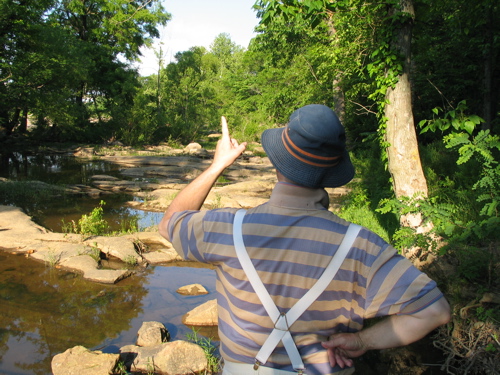
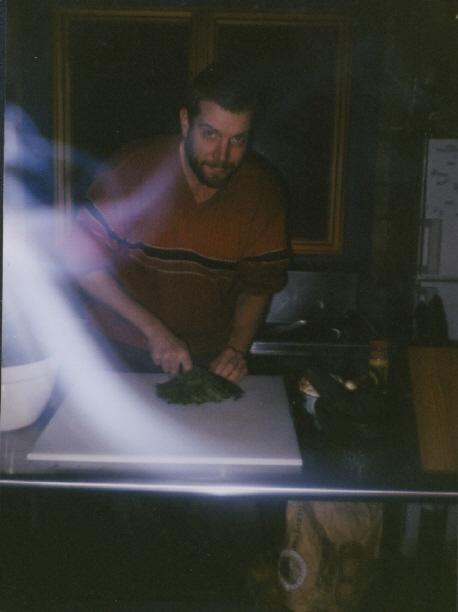
Uhl Street Ghost

See previous post's comment from Susan about the ghost that lives with she and Stephen.
Anybody else have a good ghost picture and story?
Wednesday, May 17, 2006
I Don't Know Much

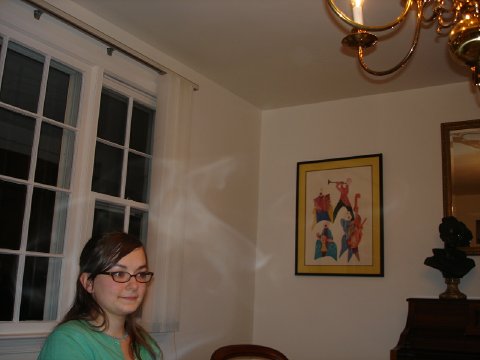
During my former life as a guy who dispensed "knowledge", made grand pronouncements of worth, and assigned grades for photographs made by people attending Frostburg State University, one of the university's maintenance guys came into my office and asked me to look at a picture. He swore it was proof of a ghost he caught on film while taking a picture of his mother. He wondered if I might be able to tell him anything about the image. Could I explain how whatever had happened happened? Was this indeed a ghost? Is there something particular about photography that enabled him to capture the ghost on the film? I told him I didn't know and had a realization like this type of interaction often causes -the kind where I take stock of what I think I know in a few seconds, and realize that when it comes to most things, I don't know much. Being of no help and feeling like I was undeserving of such a large office and such prestige, I suggested that he look at a few different websites (such as this one) and that with a little research he could find a qualified someone who could help him decide what it was that he had photographed. With me, he could get a lecture on the finer points of what it is to live in a world regulated by the photograph, and tell him how to read a photograph by any number of artists spanning the history of photography- but I didn't know what to make of this fingered 4x6 print- I didn't have a clue how to read it, and what I could give him isn't what he wanted.
I took this picture of Kim during the Mother's Day Bacchanalia held at my folks' house this past Sunday (it was really a meat fest more than anything else). I swear that's the ghost of my Pop swirling around the living room- he's watching my Nana (knowing that before too long she'll join him in the ether), listening to the music, loving the laughing, admiring how pretty Kim is, stealing a rib here and there, and shaking his head at all of the recurring conversations about sickness and death.
I would have never realized this three years ago- back then I was much too smart.
Tuesday, May 16, 2006
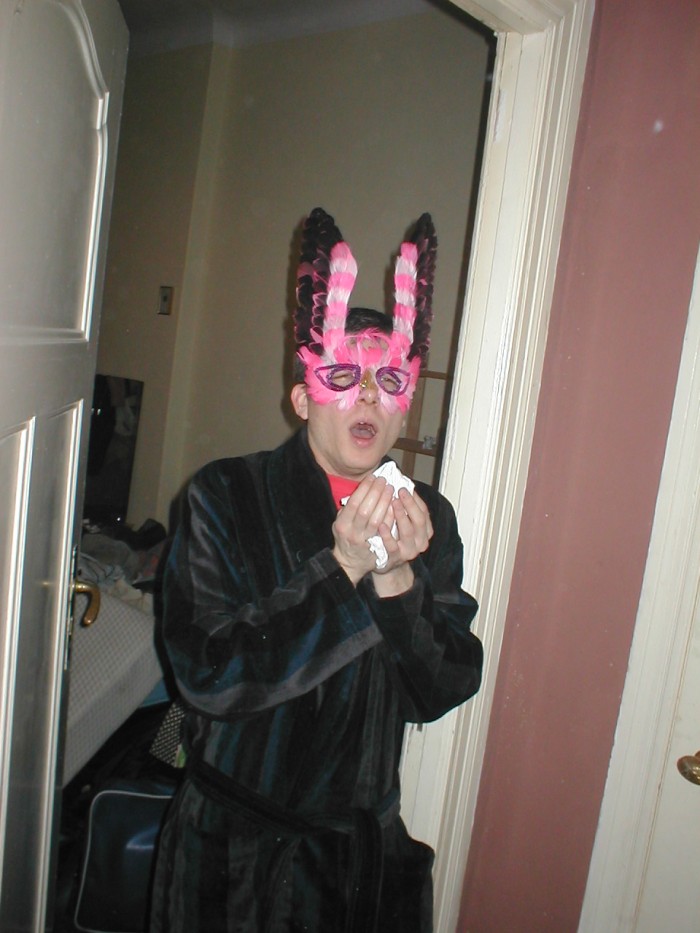
Is it the Bird Flu?
I am feeling a little better but now Kim has the sickness so I'm shuttling between work, the house where I'm house-sitting, and our apartment with soup, pills, DVDs, and sweet, sweet Afrin.
Wednesday, May 10, 2006
I know I'm dying but does it have to happen now?
I've been sick- nasty sick- for the past few days and as much as I like being at home and all of this creative loafing that I'm doing, still there are two photo grads who have work up at the Anderson that deserves some discussing. I'm going to try to make my way down there, take a few snaps and write a sentence or two. We'll see.
For the time being, I have written my most recent obit (I wrote it Monday actually) and might as well put it here. I'm a big fan of writing my obit whenever I'm sick- it makes the illness fun (and productive).
Richmond, VA Michael Lease, a self-proclaimed artist and intellectual whose work was known for blending the squeamishly personal and the conceptually droll, waxed poetic for the last time this 8th day of May. The cause of death is uncertain but people "close" to the deceased point to his new-found penchant for salted pork products, and alienating divey take-out Chinese restaurants as the likely cause. Michael leaves countless bewildered friends and family, scores of disgruntled colleagues, buckets of joyful adversaries, and many smug ex-girlfriends who now plan to sue his estate on the grounds of their having been included, without their permission, in his installation "Posthumous".
For the time being, I have written my most recent obit (I wrote it Monday actually) and might as well put it here. I'm a big fan of writing my obit whenever I'm sick- it makes the illness fun (and productive).
Richmond, VA Michael Lease, a self-proclaimed artist and intellectual whose work was known for blending the squeamishly personal and the conceptually droll, waxed poetic for the last time this 8th day of May. The cause of death is uncertain but people "close" to the deceased point to his new-found penchant for salted pork products, and alienating divey take-out Chinese restaurants as the likely cause. Michael leaves countless bewildered friends and family, scores of disgruntled colleagues, buckets of joyful adversaries, and many smug ex-girlfriends who now plan to sue his estate on the grounds of their having been included, without their permission, in his installation "Posthumous".
Tuesday, May 09, 2006
Transmissions from Texas
Like my friend Susan (see Tuesday Feb. 28th entry for details), my friends Scottie and Dan have begun sharing their family snaps with me via their online photo service company.Exciting! I'm down with OPP (other peoples' pictures)...
They live in (and hate) Houston, where Dan is in the last leg of his PHD, and Scottie has a job at a place where her email ends in .org, and where she gets to spend some time searching the internet for people we went to high school with, snatching the pics and then emailing them to me to see if I can guess who the person is.
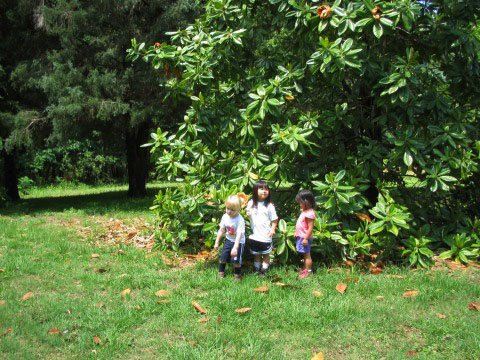
So, in today's batch of snaps that Scottie forwarded me there was this one. I think it's really pretty amazing. Each kid is in their own little world but they're all there together dwarfed by the magnolia. Each kids' center of gravity is so different- they are so wonkily arranged, It's like a behind the scenes snap of a Loretta Lux photo shoot.
Monday, May 08, 2006
John Stanmeyer
John Stanmeyer
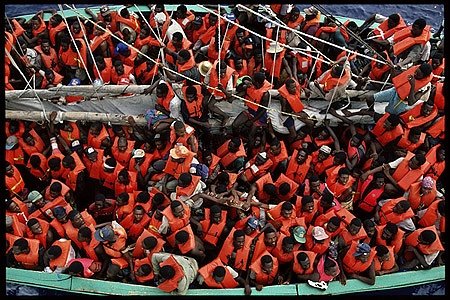
Merci Jesus, June 1994
Donned in life jackets tossed to them by the U.S. Coast Guard, 468 men, women and children from Haiti were found adrift in Bahamanian waters aboard the 55-foot Merci Jesus as they were trying to seek a better life in America. They were all taken to a refugee center on Guantanamo Bay, Cuba, where they languished for months before being returned back to Haiti. Atlantic Ocean.
At first I was taken with the name of the ship- Merci Jesus- it's so incredibly gracious and hopeful. Then I started thinking about ol' Alfie's pic The Steerage. Were the conditions of immigration then (1907) really so different from now?
Sunday, May 07, 2006
CHRIS FREEMAN!


Chris Freeman is happy when he's singing. I took pictures of him today for a press packet he's putting together to facilitate his plan for world domination via the sound waves.
His are good, stick-to-your-skull songs with titles like: The Fine Line Between Fondness and Stalking, and Don't have Sex. He's also very nice and will send you his CD for free if you drop him an email.
Friday, May 05, 2006
VCU Thesis Shows: Round 1 Installment 2
Christopher Wiedeman
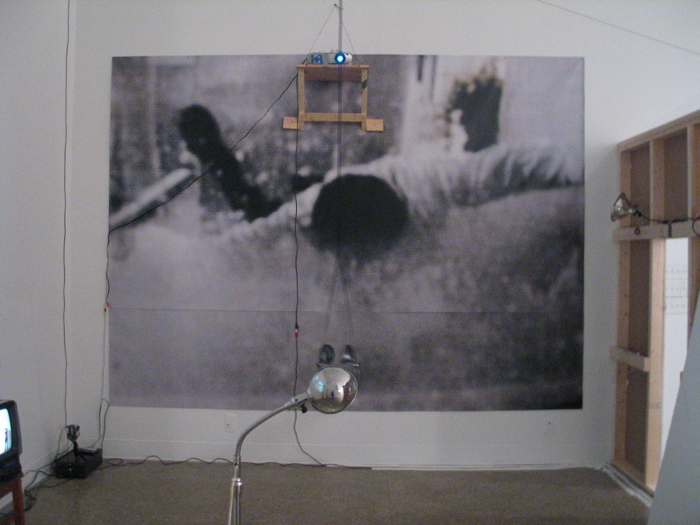
Christopher Wiedeman’s installation Slip is a calculated mess- and he likes it that way. This mess occurs around a 9’x12’ poor-quality photograph (that looks like it was lifted from a video on the web) of a man falling face first into water that is pinned to the north wall of the space. Judging by the card for the show, the photograph, also titled "Slip", is the only piece in the installation, leaving the majority of the mess to act as apparatuses for viewing the image.
Working in the vein of John Kessler, Jason Rhoades, and Cece Cole, Wiedeman presents you with his mess and expects you to do the work of putting it together. Although I find this practice dubious, lazy, honest, suspect, and (the worst) intentionally self-confounding, I nevertheless think there is a fair amount of success in Wiedeman’s installation. The space is configured with multiple video cameras, video projectors, monitors, and mirrors so that Slip (the photograph) is made visible on three of the four walls of the space. The word SLIP is written on the piece of drywall that was cut-out to make one of the roughly hewn entrances to the space (the removed piece is set aside but still in the space, and unfortunately, the word does not become the image), the south wall bears a projected video loop (the artist stomping around his studio, a landscape or two, the artist photographing into a mirror). Key moments during the loop direct the viewers’ attention to the west wall, where a live feed of the viewer, shot from a video camera positioned on the south wall at eye level, projects the image of the viewer experiencing the installation (in front of Slip – the photograph- which is, remember, on the north wall) on the west wall. While noticing that you are standing before, and are being bared down on by the image of this man falling, it is noticed that next to the image of yourself watching the video on the south wall is a live feed of yourself being watched from above. Wiedeman directs where the viewer stands in the installation by dangling headphones (the audio for the video) smack in the center of the space. With the viewer’s movement restricted by the noose-like height and positioning of the headphones, the viewer is ripe to manipulate, ripe to direct.
Slip (the installation) was one of the only installations in the thesis show that explicitly dictated the way I viewed it (the other was Randy Toy’s this-is-the -way-the- future-looks- and-it-looks-good-for-me-doesn’t-it? installation Correlations). But what it didn’t do was provide me with any sort of ideas that would enable me to take the inundation of media to a level where constructive thoughts could be furthered. I found myself thinking: Yes…this is the way it is… yes… But is there any kind of conversation more boring? I already know what I think and I go to the work of others to question the way that I perceive the world, and to find another way of looking and thinking. Slip (the installation) is a blatant, insidious, and earnest attempt to surround, flood, force, and disorient the viewer while having them experience a slice of what it is to be alive in a culture that records, measures, weighs, and commodifies every activity we engage in. That’s a lot for an installation to do, and still, it’s not enough.
Tom Condon
Unlike many of his fellow students, Tom Condon’s exhibit Everyday Haunting is comprised of two bodies of work. One body is made up of moderately sized (are they)drawings / (or are they)paintings / (they definitely can’t be) photographs made by passing a torch over strips of color photographic paper that has been stacked to make horizontal canvases. The other, are long, vertical photocopies, printed on approximately 10’x2’ sheets of white paper that have been treated with a clear encaustic.
Condon uses the torch to trace manipulated images he’s transferred to the surface. The images are of Condon and other children, taken from his childhood snapshots that he has manipulated with a copy machine so that in each image one character is made into a nearly indecipherable, genderless, ageless blob-freak. Although the turquoise and caramel colors that the flame creates when it reacts with the photo paper are attractive hues, I feel like I can’t be bothered with the pieces. They are messy, graceless, overworked, poorly framed, and make me think of entering a restaurant and being grossed-out by its dirty, fingerprint-smudged glass entrance doors. I feel like on the surface of these pieces there are sneezes, germs, and live active cultures!
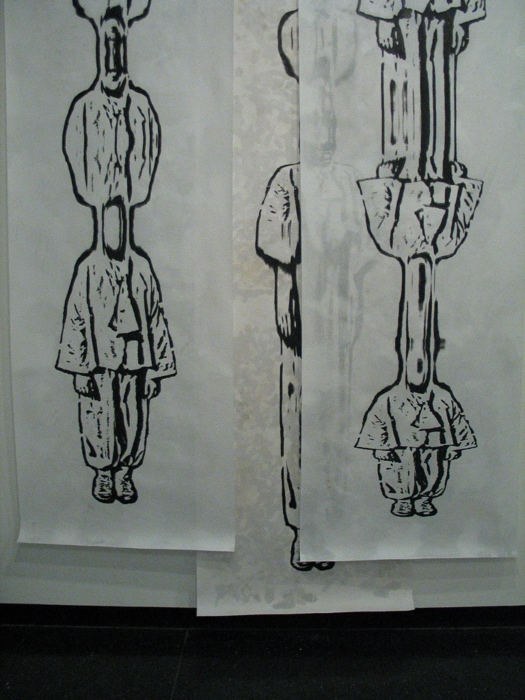
The pieces that make up Reading out Loud (ROL) are a whole different animal. ROL consists of 4 “photo copy encaustic(s)” each made on approximately 2’x 8’ sheets white paper that were hung vertically (and loosely with binder clips and nails) in the second gallery’s east wall, on the Anderson’s first floor. Three of the images were grouped together, and overlapping so that the three together bring to mind large swaths of fabric, or curtains. On the other side of the high, arched doorway the fourth image- sequestered from the others (not unlike Rafferty’s bubble video) hung lower than the other three. Knowing that Condon and Rafferty share a studio, I find the similarity between the two exhibits interesting- or even promising, not distracting or derivative. The imagery in ROL, like that in the work mentioned above is made from manipulating snapshots (in this case a single snapshot of Condon in a clown-like outfit of baggy ankle-cinched trousers and a poncho like blouse) with a black and white photocopier. But instead of the image being manipulated horizontally the image is stretched vertically and the images resemble funhouse-mirror reflections and make me think of how, as a child whenever I looked at myself in one of those mirrors I was happy that I didn’t look like my reflection.
The image, being black and white and photocopied, takes the work away from being merely solipsistic, but because of its goofiness, and because all we are left with is a psychedelic pattern, a funny outfit, a smile, and a bowl cut, the image might as well be a found photograph. This is problematic- nothing significant is conveyed in the face of this figure- that smile could mean a million things, but because of the quality it means nothing and is an empty and generic happiness that I am unwilling to believe. Like Land’s, and Wiedeman’s work, Condon’s leaves me wanting for some direction. With no direction, I’m left with thinking that the work is more a decorative exercise (which it does well) than an attempt to communicate. But still, I’m not convinced this is the point.
Working in the vein of John Kessler, Jason Rhoades, and Cece Cole, Wiedeman presents you with his mess and expects you to do the work of putting it together. Although I find this practice dubious, lazy, honest, suspect, and (the worst) intentionally self-confounding, I nevertheless think there is a fair amount of success in Wiedeman’s installation. The space is configured with multiple video cameras, video projectors, monitors, and mirrors so that Slip (the photograph) is made visible on three of the four walls of the space. The word SLIP is written on the piece of drywall that was cut-out to make one of the roughly hewn entrances to the space (the removed piece is set aside but still in the space, and unfortunately, the word does not become the image), the south wall bears a projected video loop (the artist stomping around his studio, a landscape or two, the artist photographing into a mirror). Key moments during the loop direct the viewers’ attention to the west wall, where a live feed of the viewer, shot from a video camera positioned on the south wall at eye level, projects the image of the viewer experiencing the installation (in front of Slip – the photograph- which is, remember, on the north wall) on the west wall. While noticing that you are standing before, and are being bared down on by the image of this man falling, it is noticed that next to the image of yourself watching the video on the south wall is a live feed of yourself being watched from above. Wiedeman directs where the viewer stands in the installation by dangling headphones (the audio for the video) smack in the center of the space. With the viewer’s movement restricted by the noose-like height and positioning of the headphones, the viewer is ripe to manipulate, ripe to direct.
Slip (the installation) was one of the only installations in the thesis show that explicitly dictated the way I viewed it (the other was Randy Toy’s this-is-the -way-the- future-looks- and-it-looks-good-for-me-doesn’t-it? installation Correlations). But what it didn’t do was provide me with any sort of ideas that would enable me to take the inundation of media to a level where constructive thoughts could be furthered. I found myself thinking: Yes…this is the way it is… yes… But is there any kind of conversation more boring? I already know what I think and I go to the work of others to question the way that I perceive the world, and to find another way of looking and thinking. Slip (the installation) is a blatant, insidious, and earnest attempt to surround, flood, force, and disorient the viewer while having them experience a slice of what it is to be alive in a culture that records, measures, weighs, and commodifies every activity we engage in. That’s a lot for an installation to do, and still, it’s not enough.
Tom Condon
Condon uses the torch to trace manipulated images he’s transferred to the surface. The images are of Condon and other children, taken from his childhood snapshots that he has manipulated with a copy machine so that in each image one character is made into a nearly indecipherable, genderless, ageless blob-freak. Although the turquoise and caramel colors that the flame creates when it reacts with the photo paper are attractive hues, I feel like I can’t be bothered with the pieces. They are messy, graceless, overworked, poorly framed, and make me think of entering a restaurant and being grossed-out by its dirty, fingerprint-smudged glass entrance doors. I feel like on the surface of these pieces there are sneezes, germs, and live active cultures!
The pieces that make up Reading out Loud (ROL) are a whole different animal. ROL consists of 4 “photo copy encaustic(s)” each made on approximately 2’x 8’ sheets white paper that were hung vertically (and loosely with binder clips and nails) in the second gallery’s east wall, on the Anderson’s first floor. Three of the images were grouped together, and overlapping so that the three together bring to mind large swaths of fabric, or curtains. On the other side of the high, arched doorway the fourth image- sequestered from the others (not unlike Rafferty’s bubble video) hung lower than the other three. Knowing that Condon and Rafferty share a studio, I find the similarity between the two exhibits interesting- or even promising, not distracting or derivative. The imagery in ROL, like that in the work mentioned above is made from manipulating snapshots (in this case a single snapshot of Condon in a clown-like outfit of baggy ankle-cinched trousers and a poncho like blouse) with a black and white photocopier. But instead of the image being manipulated horizontally the image is stretched vertically and the images resemble funhouse-mirror reflections and make me think of how, as a child whenever I looked at myself in one of those mirrors I was happy that I didn’t look like my reflection.
The image, being black and white and photocopied, takes the work away from being merely solipsistic, but because of its goofiness, and because all we are left with is a psychedelic pattern, a funny outfit, a smile, and a bowl cut, the image might as well be a found photograph. This is problematic- nothing significant is conveyed in the face of this figure- that smile could mean a million things, but because of the quality it means nothing and is an empty and generic happiness that I am unwilling to believe. Like Land’s, and Wiedeman’s work, Condon’s leaves me wanting for some direction. With no direction, I’m left with thinking that the work is more a decorative exercise (which it does well) than an attempt to communicate. But still, I’m not convinced this is the point.
Tuesday, May 02, 2006
VCU Thesis Shows: Round 1
My decision to post all of these words marks a turning point in my writing about art on this blog. The arrival of this season’s graduate thesis shows at VCU, and the sudden, wonderful appearance of photo/time based work has made me question whether I want my talk of art on this space to be that posted by a reviewer or a critic. I’m choosing the latter- there are plenty of reviewers (of all things) in the blogosphere, in the newspapers, on TV, and in our daily exchanges. There aren’t enough critics.
Because there are so many words I am going to post serially- two artists today, two more tomorrow...
“The eyes are organs of asking” – Paul Valéry
Round One of VCU’s graduate thesis show leaves me, in large part wanting for more. Specifically, the majority of the work leaves me wanting for work made by artists whose urge to communicate reaches beyond the closed doors of their graduate classes, personal websites, need for self expression, or their want of commercial success. I am plagiarizing (though paraphrasing) AD Coleman when I write that to be a an artist (Coleman differentiates between professional and amateur artist but I am talking about professional artists when I write artist) connotes a sincere wish to communicate (and with the VCU work in mind, I give the students the benefit of the doubt, as so far all of these people are professional students, not professional artists, but I assume that they will all embark on a career of art making beyond their experiences in Graduate school, and so I give them the benefit of the doubt) with the community of viewers that consume the work. So, when I walk into the Anderson Gallery I am looking to have some sort of dialogue with the work in front of me. It is too infrequent that this happens. I imagine that there are plenty of conversations had around the work on view but I would venture to say the words being exchanged are largely those of such a small demographic, and that the conversation couldn’t possibly be made public without each persons’ participation in a couple of years of graduate school, a subscription to Artforum, and a big bowl of Duchamp soup.
With that out of the way, I’m going to limit my critique to the photo, and time-based work made by the graduate students of Photo/Film. They are a barely noticed group (I was one of them so any familiarity you may sense is justified and potentially debateable), and they are illustrative of not only current trends in art making but of art making as it applies to the current climate of photography being accepted (read: sold) by the “Art World”. It is not an accident that of all of the work I write about here, none of the pieces resemble “fine art” photographs. Interesting too, these artists have had, as professors the likes of Gary Schneider, Lynne Cohen, Elizabeth Subrin, and Chris Sperandio.
Robbie Land
Robbie Land’s video (16mm color film transferred to DVD) New Berlin, occupied a small room on the mezzanine, next to the bathrooms. During my first visit I was primarily interested in thinking about Land’s decision to show in such an intimate space- his having painted the room black, the chairs chosen (only two), and the six speakers that filled the room- 4 fairly new, two from a home stereo system (simulated wood grain with patterned mesh grill) allows for the viewer to be completely immersed (or plunged as it may be) into the world of his film. Land uses the familiar space of the movie theatre to his advantage- everyone knows what to do in this space and of all of the artists featured in this show, Land is the only one that demands (and placed his work in such a context to be able to do so) this type of attention.
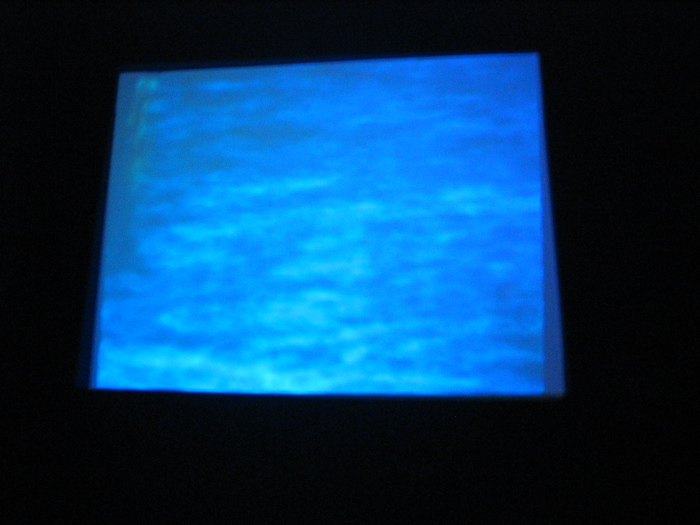
New Berlin, (named after the location where Land filmed), is a poetic, painterly mash-up of sound and imagery- it’s murky, handheld, cool-toned 16mm fare, edited in a loosely narrative sequence that seems to be concerned with (if anything other than looking good) the efforts of navigation. New Berlin clocks in at a short, and sweet 3-4 minutes. All filmmakers should take a cue from pop musicians and not make videos that are longer than the average pop song. New Berlin is filmed in first person and Land takes the viewer on a journey from beneath, to above and back to below a waters surface. There are boots being lapped at by water on a pier, close-ups of a compass (presumably on one of the ships that are shown), and near the end, the camera dives into the water a couple of times (first into a reedy patch of shallow water, and then into a gorgeous school of goldfish swimming to the soundtrack of a bullhorn) before succumbing completely to being under water and watching as a jellyfish (not know for their speed) swims by. Like all of Land’s films, audio is paramount in New Berlin and it fuses together the sometimes-disparate images with the rhythmic flicker of the projected film. Presumably, the audio tracks (maybe 4?) are culled from New Berlin (the place) as well, but it could easily be that many of them were not. I’m not sure it matters. The audio has the sound (and when paired with the imagery, the appearance) of someone poring over hours of audio and picking out (and refining) the phrases best suited for the collected images.
Metaphorically, Land’s concerns are pretty clear- life, as well as the making of a film is a series of struggles with (and within) the self, as well as with the world outside of the self, and this film points to how we all try to learn how to use the tools given to us to figure out how to make our way through this mess. That is a tried and true impetus for art making but there needs to be more. The problems with New Berlin aren’t the images and it’s not the audio. It’s the decision to pair the two together. I believe Land is a musician skilled at crafting lugubrious soundtracks out of found sounds – he’s a filmmaker skilled at weaving rhythmic pastiches of romantic, abstract expressionist, DIY, Brakage-ish, cutting-room-floor stuff that hipster cred is made of. What’s the problem then? The problem is that the film is all persecution and no resurrection. It’s self conscious indie fare and when I sit down to watch a film I hope to learn that there is another person out there who has figured out a way to make it through this mess and I’m disappointed to find someone content to flail in the murky waters of abstract and expressionist unknowing (this is the same reason I don’t listen to music by bands like Godspeed You! Black Emperor or Blonde Redhead). I’d suggest to Land that he begins collaborating, ask his professor Sonali Gulati how it felt to have people connect to her and her film at the Black Maria Film Festival or, if nothing else set himself some parameters- like forcing himself to make a film (and accompanying audio track) that clocks in at more than 60 bpm. Then maybe there could be a little balance- a little resurrection with our oftentimes-necessary persecution.
Eileen Rafferty
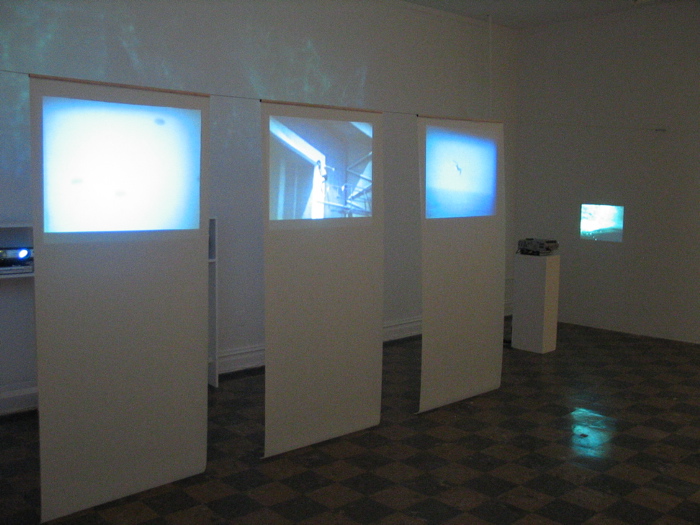
Way up on the 3rd floor, in the northwest corner, in a low ceilinged, square tiled room of the Anderson Gallery was Eileen Rafferty’s 4-channel video installation jimmy hit his first home run. For this installation Rafferty employed three long scrolls of white paper attached equidistance apart, to a wire strung between the gallery’s north and south walls as projection screens for three of the videos. The scrolls were coated with a transparent substance (gel medium?) and the video was projected onto them from behind, the gel medium caused the light from the videos to reflect a swimming pool like pattern on the west walls. The imagery was culled from Rafferty’s late father’s 8mm home movies (edited down by Rafferty so that each sequence was no longer than a minute). The fourth projection, shot with a video camera, was projected onto the wall adjacent to the scrolls. This slow, color video of bubbles rising in front of a backdrop of a setting, stormy sun is significantly different hue and image quality from the rest. If the footage on the scrolls could be viewed as the parents’ table, the bubble video is the table set aside for those not mature enough to sit with the adults- it’s next to the parents table, but smaller, lower, and out of the way. This division makes it clear that this is the lesser of the images in the installation. Rafferty does herself a disservice by treating the video this way- the bubbles are so surprisingly meaningful and beautiful that it would have been excellent company, and worked as a good counterbalance for the other videos.
Rafferty’s decision to segregate and thereby create a hierarchy among makes me think that her choice to separate the videos is evidence of the common trap that photographers, and other practitioners who work in series and editions, fall into- the tendency to present only stylistically and conceptually consistent work near one another. Photography loves the stain around the bathtub- the series of images, all the same size, and all printed and mounted in a way so similar that all the viewer needs to do (because oftentimes the imagery is also the same idea beaten to death twenty-plus times) is quickly walk around the gallery, with their nose about 10-12 inches from the glass, make a quick appraisal, and then zoom-- they’re out the door thinking that the image on the postcard was really all that was necessary.
But, despite this segregation of images, Rafferty’s installation transcends this limitation and the images occupy that sad, beautiful and familiar space that Felix Gonzalez Torres’ images and sculpture occupy. Hers too are archetypical images that already exist within us- most of us have thought about the violence and beauty of the high dive, we’ve all put ourselves in the place of skydivers, which of us hasn’t wanted to fly, and when weren’t we fascinated by the short life of a blown bubble? Life and death surround our every thought, dream and action. jimmy hit his first home run works beacuse Rafferty knows that in order for us to experience this work and these simple truths, she needn’t worry about giving us much- all she gives us (and it’s just the right amount) is an elegant synthesis of light, material, and close to home imagery that makes the viewing of the installation at once embarrassingly personal and necessarily universal.
Because there are so many words I am going to post serially- two artists today, two more tomorrow...
“The eyes are organs of asking” – Paul Valéry
Round One of VCU’s graduate thesis show leaves me, in large part wanting for more. Specifically, the majority of the work leaves me wanting for work made by artists whose urge to communicate reaches beyond the closed doors of their graduate classes, personal websites, need for self expression, or their want of commercial success. I am plagiarizing (though paraphrasing) AD Coleman when I write that to be a an artist (Coleman differentiates between professional and amateur artist but I am talking about professional artists when I write artist) connotes a sincere wish to communicate (and with the VCU work in mind, I give the students the benefit of the doubt, as so far all of these people are professional students, not professional artists, but I assume that they will all embark on a career of art making beyond their experiences in Graduate school, and so I give them the benefit of the doubt) with the community of viewers that consume the work. So, when I walk into the Anderson Gallery I am looking to have some sort of dialogue with the work in front of me. It is too infrequent that this happens. I imagine that there are plenty of conversations had around the work on view but I would venture to say the words being exchanged are largely those of such a small demographic, and that the conversation couldn’t possibly be made public without each persons’ participation in a couple of years of graduate school, a subscription to Artforum, and a big bowl of Duchamp soup.
With that out of the way, I’m going to limit my critique to the photo, and time-based work made by the graduate students of Photo/Film. They are a barely noticed group (I was one of them so any familiarity you may sense is justified and potentially debateable), and they are illustrative of not only current trends in art making but of art making as it applies to the current climate of photography being accepted (read: sold) by the “Art World”. It is not an accident that of all of the work I write about here, none of the pieces resemble “fine art” photographs. Interesting too, these artists have had, as professors the likes of Gary Schneider, Lynne Cohen, Elizabeth Subrin, and Chris Sperandio.
Robbie Land
New Berlin, (named after the location where Land filmed), is a poetic, painterly mash-up of sound and imagery- it’s murky, handheld, cool-toned 16mm fare, edited in a loosely narrative sequence that seems to be concerned with (if anything other than looking good) the efforts of navigation. New Berlin clocks in at a short, and sweet 3-4 minutes. All filmmakers should take a cue from pop musicians and not make videos that are longer than the average pop song. New Berlin is filmed in first person and Land takes the viewer on a journey from beneath, to above and back to below a waters surface. There are boots being lapped at by water on a pier, close-ups of a compass (presumably on one of the ships that are shown), and near the end, the camera dives into the water a couple of times (first into a reedy patch of shallow water, and then into a gorgeous school of goldfish swimming to the soundtrack of a bullhorn) before succumbing completely to being under water and watching as a jellyfish (not know for their speed) swims by. Like all of Land’s films, audio is paramount in New Berlin and it fuses together the sometimes-disparate images with the rhythmic flicker of the projected film. Presumably, the audio tracks (maybe 4?) are culled from New Berlin (the place) as well, but it could easily be that many of them were not. I’m not sure it matters. The audio has the sound (and when paired with the imagery, the appearance) of someone poring over hours of audio and picking out (and refining) the phrases best suited for the collected images.
Metaphorically, Land’s concerns are pretty clear- life, as well as the making of a film is a series of struggles with (and within) the self, as well as with the world outside of the self, and this film points to how we all try to learn how to use the tools given to us to figure out how to make our way through this mess. That is a tried and true impetus for art making but there needs to be more. The problems with New Berlin aren’t the images and it’s not the audio. It’s the decision to pair the two together. I believe Land is a musician skilled at crafting lugubrious soundtracks out of found sounds – he’s a filmmaker skilled at weaving rhythmic pastiches of romantic, abstract expressionist, DIY, Brakage-ish, cutting-room-floor stuff that hipster cred is made of. What’s the problem then? The problem is that the film is all persecution and no resurrection. It’s self conscious indie fare and when I sit down to watch a film I hope to learn that there is another person out there who has figured out a way to make it through this mess and I’m disappointed to find someone content to flail in the murky waters of abstract and expressionist unknowing (this is the same reason I don’t listen to music by bands like Godspeed You! Black Emperor or Blonde Redhead). I’d suggest to Land that he begins collaborating, ask his professor Sonali Gulati how it felt to have people connect to her and her film at the Black Maria Film Festival or, if nothing else set himself some parameters- like forcing himself to make a film (and accompanying audio track) that clocks in at more than 60 bpm. Then maybe there could be a little balance- a little resurrection with our oftentimes-necessary persecution.
Eileen Rafferty
Rafferty’s decision to segregate and thereby create a hierarchy among makes me think that her choice to separate the videos is evidence of the common trap that photographers, and other practitioners who work in series and editions, fall into- the tendency to present only stylistically and conceptually consistent work near one another. Photography loves the stain around the bathtub- the series of images, all the same size, and all printed and mounted in a way so similar that all the viewer needs to do (because oftentimes the imagery is also the same idea beaten to death twenty-plus times) is quickly walk around the gallery, with their nose about 10-12 inches from the glass, make a quick appraisal, and then zoom-- they’re out the door thinking that the image on the postcard was really all that was necessary.
But, despite this segregation of images, Rafferty’s installation transcends this limitation and the images occupy that sad, beautiful and familiar space that Felix Gonzalez Torres’ images and sculpture occupy. Hers too are archetypical images that already exist within us- most of us have thought about the violence and beauty of the high dive, we’ve all put ourselves in the place of skydivers, which of us hasn’t wanted to fly, and when weren’t we fascinated by the short life of a blown bubble? Life and death surround our every thought, dream and action. jimmy hit his first home run works beacuse Rafferty knows that in order for us to experience this work and these simple truths, she needn’t worry about giving us much- all she gives us (and it’s just the right amount) is an elegant synthesis of light, material, and close to home imagery that makes the viewing of the installation at once embarrassingly personal and necessarily universal.
Monday, May 01, 2006
Happy May Day
May 1 is always a strange day for me, I spend most of the day thinking about work, workers, my not liking work or being a worker, my Sicilian grandfather who, after agitating for a union of the plumbers that he worked with was fired and spent the rest of his life as a facilities guy, Spring, germination, fertility, sex, anarchism, anarchists, solidarity, parades, maypoles, and creative loafing. But these are things that most people would like me to keep to myself- yes, most people have a respect for fertility, Spring, work, and sex, but work is really the only one that is permissible fodder for water cooler banter so I spend the day feeling alienated and aloof, looking outside and imagining a place where this day, and this person that I am, and that you are, are valued for their ties to the Earth, history and labor. Alas, what this means is that I have recurring flashes of orgiastic, Russ Meyers-like sex scenes going through my head all day- not really so different from any other day but today I really don't feel guilty, actually I feel entitled to strut around like some wimpy Pan of the not for profit world.
But today seems a little different.
More important than my ruminations is the nation-wide protest that our immigrant brethren (I write that without a touch of irony) are engaging in today in an attempt to show America what an integral part of our economy the immigrant population is. Hats off to the brown people of this country who are so taken for granted by the white people of this country. If the brown people weren't picking those oranges, who would be? And how much would that half gallon of OJ cost? The division being sold to, and consumed by the American public is the action of a classist, racist (which is, I believe more an issue of class than skin color), xenophobic, dominant class of bullies who don't want anyone, least of all brown people to play with their toy.
My mother's family (the Zinos and the Sturniolos) immigrated from Sicily at the turn of the century (they were a part of a large group of politically-progressive Italians who came to the US to be a part of what was a viable alternative to the oppression they were experiencing in their native country). To people who insist that immigrants learn English, I have this to say: It's true my great grandmother never learned to speak English very well and she may have annoyed an Anglo or two during her trips to the store- but her daughter (my Nana) only knows a handful of words in Sicilian, she uses the name Katie instead of her birth name Concetta, and my mother (Serafina, goes by Serry) knows almost no Sicilian whatsoever, and then me, it goes (almost) without saying that the itty bit of Italian I know is not worth a mention. My point? People immigrate to the US in hopes of having a better life, one not under the watchful eye of dictators who disappear people in the middle of the night, people come here so they can work and save enough money to send their kids to college, so they can take part in what it is to be American, the right to choose, and yes, especially the right to shop. The common language of America is not English and it doesn't need to be- as long as immigrants have cash, debit, and credit cards, and our interactions at stores become increasingly automated, there really is no reason for Juanita, or Kwabena to speak English In less than a generation their children will speak English and adopt American mannerisms, mores, and habits.
What has me most concerned about this current situation is how all of this crap is going to affect my daily interaction with immigrants. I live in a snooty Richmond neighborhood and there are Latino families who on Sundays stroll along the sidewalks, sometimes all holding hands, and they smile at me, and I smile back. There are no black families doing that in my neighborhood. In fact any black people in my neighborhood keep their heads down and are in an obvious hurry to get to where they know they are allowed to be. I worry that the publicity that this issue is getting is going to actually create a situation that doesn't actually exist. Are as many Americans as the press would have me believe really opposed to the growing immigrant communities? Or will the flare up of this issue actually cause there to be a time when I pass by Latinos, Africans, and Asians and feel the same surge of resentment, terrible history, and hate that I feel so often when I pass a black person on the street? I fear that we are being Balkanized right before our eyes.
Adios companeros.
Sunday, April 30, 2006
Mixed Tape from Hell
This afternoon following a good brunch at Joe's Inn on Shields, Charles and I took a long walk through the Fan. We stopped to smell all of the blooms that were smelling, we talked about the sky, the houses, the decision (for some) to cover the side of their houses in stucco (I'm for it- Charles, usually a naysayer (at first), isn't 100% behind the idea), we yakked about the stained glass in the Cathedral of the Sacred Heart (again, there's me who says yea, and again, there's Charles with his nay), as well as my latest series of ridiculous photographs (Charles says huh?). All the while I had my eyes to the ground and in the trash cans and found a good amount of booty.
Most of it is pretty standard fare (discarded snapshots) but what's interesting about all of the pictures is that they are all of adolescents. I am accustomed to finding baby pictures, and tons of snaps of reveling college students after what has undoubtedly been a very demanding week of studies. But peeking into (even the photographic version of) adolescence is fascinating.
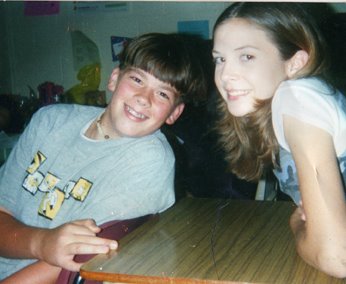
How long will it be until the lives of these girls resembles the lives of the characters in Mean Girls? When will all the pimples come?
Is she completely in love with this little guy? Or is this the girl he's been asking to go with him for the past six months but because she occupies a social tier a couple above his own, she must ignore her feelings and say no?And then finally, on the 2100 hundred block of Grove, in the front yard of a house which was on fire a few days ago, I found this tape. It seemed too perfect an accompaniment to the the pictures- too metaphoric for this guy who claims metaphasia on the top of his list of
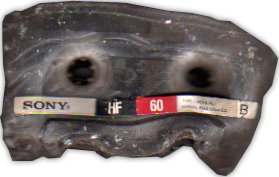
culturally induced illnesses. And that's when I realized that it wasn't their adolescence I was thinking about, it was my own. These kids have little (if any) relationship with analog 1/4 inch tape. But for me, this was the stuff that my adolescence was made of. Tapes like this held my world, and I routinely tried to place my world onto one. The careful crafting of side A (this was the upbeat side) usually an ironic mix and the perfect companion to side B (a lugubrious mix of painfully melodramatic music made by men who wore a lot of make up) this was the side that I really cared about - the side that I was sure contained all the ju ju necessary to communicate just how important the recipient of the tape was. These tapes were my plumage - with this tape they would be allowed to glimpse just how interesting, cute and existential I was. They were (I realize now) mixed tapes from hell- culled songs used to plunge me only deeper into, and act as, the soundtrack for my privileged cafard.
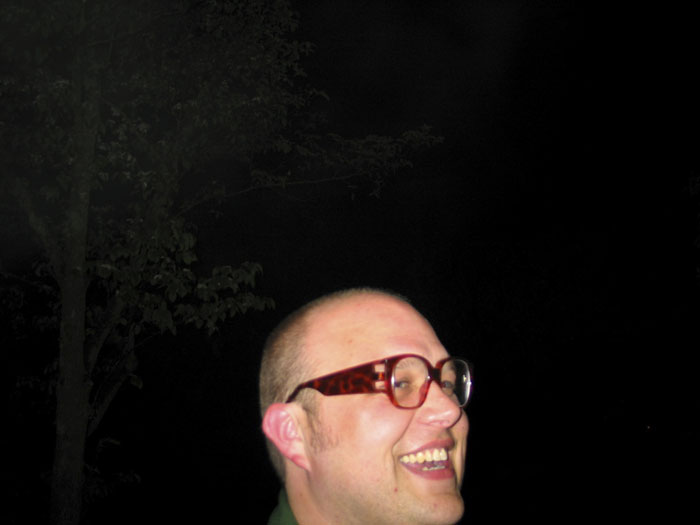
Tuesday, April 25, 2006
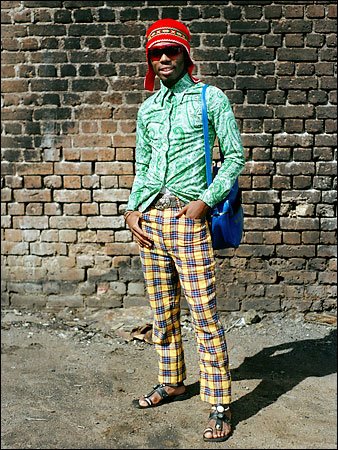
Africa

Here's something Kim and I didn't do in NY and really regret: we didn't go see the show at ICP Snap Judgements: New positions in Contemporary Photography.
"Thulani" (2004) by Nontsikelelo "Lolo" Veleko
Sunday, April 23, 2006
Head on a Stick!

This is Tom Condon, one of the VCU photo/film grad students who had their opening this past Friday. That smile is always close to Tom's lips but he and his phellow photo phriends had a lot to smile about this night.
Saturday, April 22, 2006
Her Bangs Were Like the Sun


When you are young, you always expect that the world is going to end. And then you get older and the world still chugs along and you are forced to re-evaluate your stance on the apocolypse as well as your own relationship to time and death. You realize that the world will indeed continue, with or without you, and the pictures you see in your head. So you try to understand the pictures instead.
p. 108 of Douglas Coupland's Life After God
Look at Me Looking at Me
Death By Musette (sans Todd but it still counts) was the house band for Horsey's Two Hour Variety Hour tonight. This evenings performance/show went much better than a month ago (much smoother). I am essentially Paul Schaefer and just figured out when there needed to be some music- Horsey even addressed his post monologue, pre-guest banter to me. What's more, the scheduled guests showed up and Horsey had an uncomfortable but ok "conversation" with a professor from VCU who has his degree in Islamic studies and is a Muslim.George took this picture.

Mermaid Skeletons were the musical guest and were really great- two earnest, funny, young guys singing beautiful, faith-infused songs with hushed guitars and excellent harmonies. Their goodness (or their sincere intention) reminded me of all the good people of Western Maryland who pick up instruments and make music that I listen to: Jon Felton's Soulmobile, Page France, The Lyric Opera... They asked if I'd be interested in doing some recording with them on the cd they are working on. I said yes.
The world is a big exciting place if you allow it.
Thursday, April 20, 2006
GO

Martin over at Anaba directed me to an upcoming call for entries at local Richmond cum Brooklyn hipsterwares boutique Nonesuch , their website lead me to their links in hopes of finding their designer which led me to this.
Go. Just search for the place to click. Delicious is my favorite path.
Wednesday, April 19, 2006
Occupational Hazard

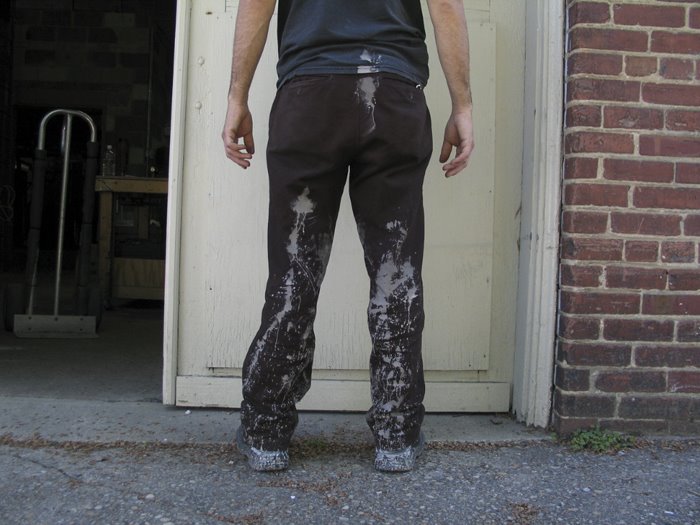
That's clay sludge (slip) from a bag of trash that I was hauling to the dumpster this afternoon at work. Despite the inconvenience, I think it was kind of pretty- the light brown of the slip against the dark brown of my pants. If only it had happened yesterday when I had on that blue/gray shirt...
NYC snaps are on the way.
Wednesday, April 12, 2006
Off to NYC

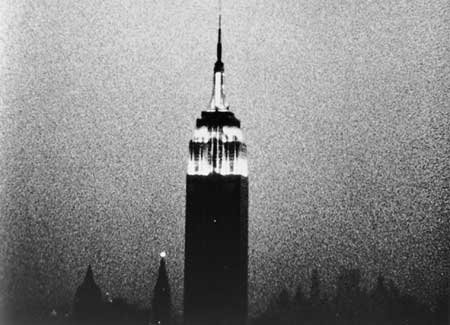
Tomorrow morning Kim and I are headed to a city where even the buildings are superstars. The plan is to pack a month's worth of activities into four days, we'll see how far we get.
Saturday at 2pm we'll be having a picnic at the Belvedere Castle in Central Park, if you can make it, please come but bring your own food and don't expect us to hang around too long- we have plans to make it to The Main Squeeze before it closes at 6pm.
Talk to you soon...
Tuesday, April 11, 2006
Brought to You by the Inverted Numbers 2 and 3

So here we are at The Cornerstone Gallery last Friday. Playing outside of the house is a lot of fun, Todd is much better at it than I am, but fortunately there was a TV directly above Todd's head for me to watch so I was able to keep myself distracted from the throngs of admirers asking us what the secret was to our keeping our hair so dark and greasy.
Friday, April 07, 2006
White Night on Broad Street with Death By Musette
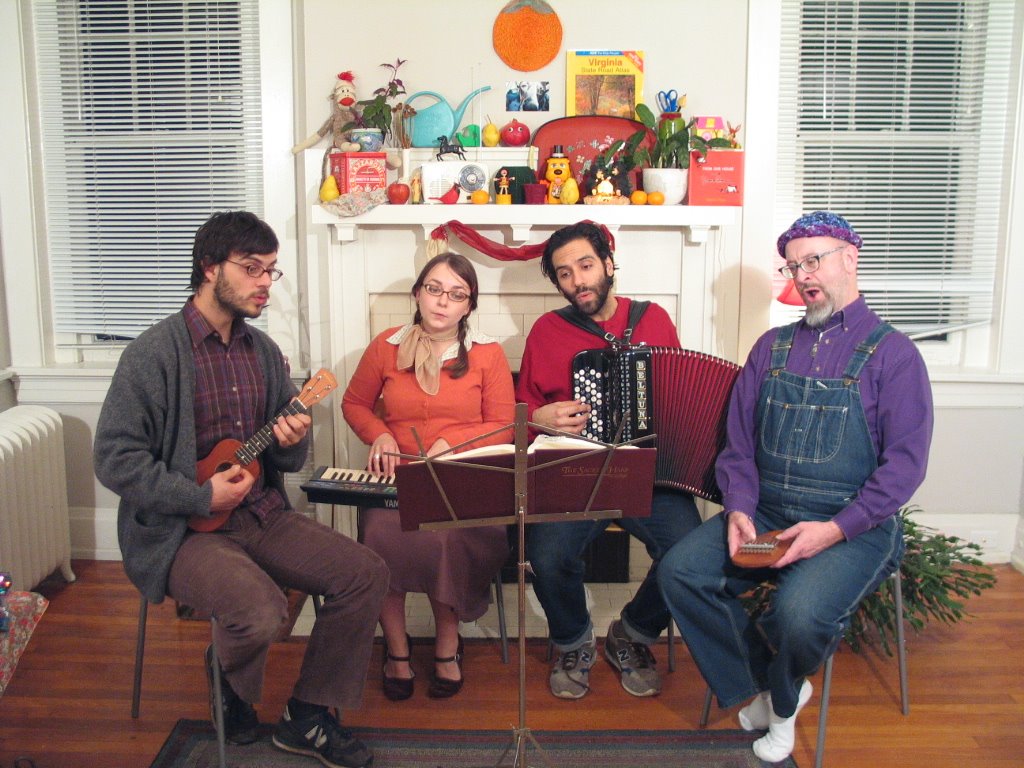
Todd and I (shown here in a holiday promotional with Gustina! Gustina! and Mama Kim) are playing at Cornerstone Gallery tonight during Michael McDevitt's opening. Michael is a painter from Richmond and this is his first solo show so there should be lots of good (albeit nervous) energy.
Also tonight is an opening at VACR of work by Jack Wax (pictured above) and Judith Schaechter. For his largest piece in the show, Jack pieced together hundreds of glass tubes which are strung together with wire and create an oddly stable structure that reminds me of both a tent and a Buckminster Fuller dome gone awry.
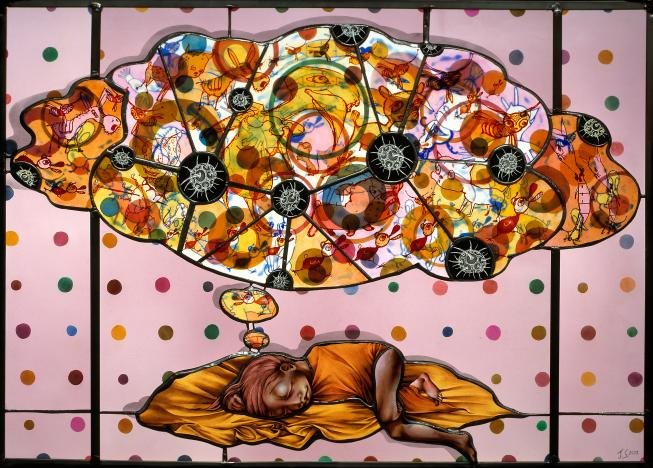
Judith's work (the above is not in the show but I had to search around online) is amazing. If you've never seen it, you have the chance to check out ten of her pieces that span from 1996-2003- is this a mini retrospective?Jack and Judith are also giving a gallery talk Sunday at 2pm.
Wednesday, April 05, 2006
November 1, 1992-April 5, 2005

I walked home from work today trying to imagine what it felt like to have Annabelle pull on the leash. I looked at things that I thought she might stop and sniff. I walked behind our old apartment on Grove Avenue and around all of the alleys in the neighborhood. I heard sounds that would have startled her. And finally, I walked much further than her 12 year old self would have liked.
I cannot believe how much I miss my sweet, sweet girl.
Tuesday, April 04, 2006
Why I Love Spring
Walking home from work today I came upon a number of trash cans brimming with some of the first Spring clean-outs. I could smell the goods as I dug around while Charles tried to get me to pay at least a little bit of attention to a nearby yard flanked by magnolias and a cherry tree.
There were a lot of magazines from the late seventies and early eighties, a few lampshades, a pair of brown leather shoes, a couple bags of screws, and a small box that contained what I imagine were the contents of some recently deceased person's desk drawer (the "main"drawer where pens, paper clips, stamps and a calculator are kept).
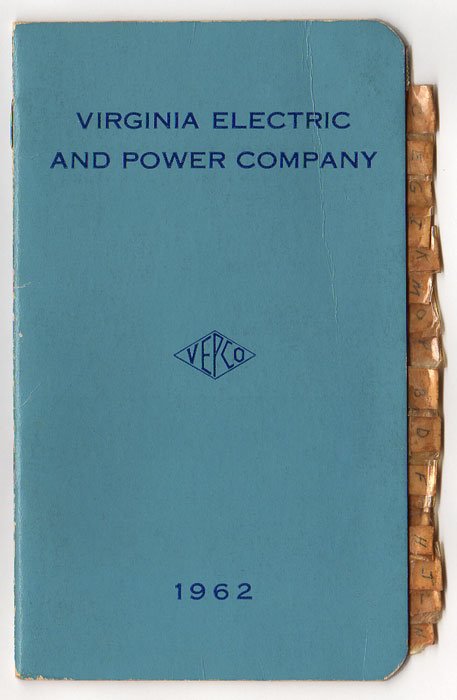
This is great because the person (Kim and I think a woman) retrofitted a free calendar with letter tabs to make their own address book.
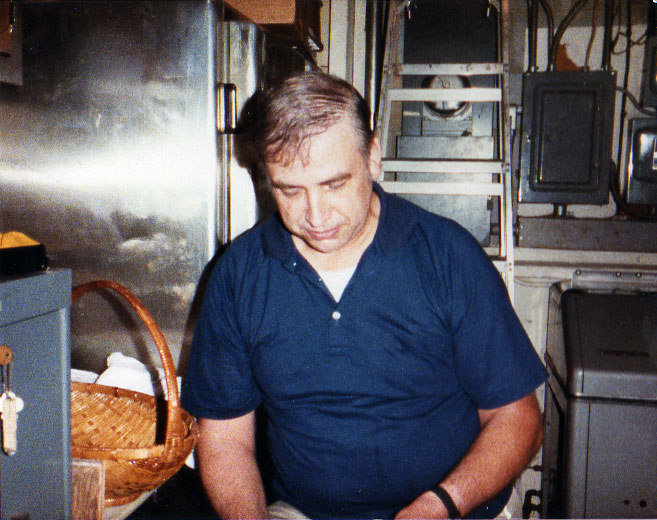
There were two photographs in the little box. There's this one of a guy in what looks like a church basement (or maybe he owned a restaurant- or maybe this is the kitchen at the old Gandalf's?).
Then there's this one of a couple cutting their wedding cake. Charles and I both thought it looked like they got married at Bryant Park- near the playing fields (but more importantly, near the Meadow). Without a doubt the bridesmaid takes the cake- click on her to get a better look. I've found quite a few wedding pictures, maybe during June I'll do a special found wedding album.
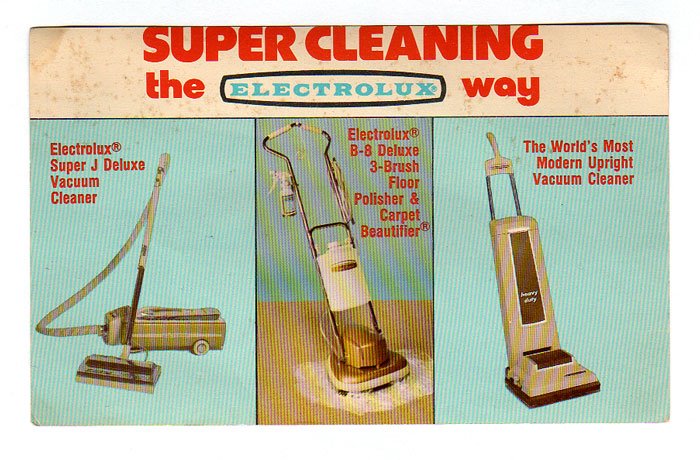
This postcard was also in the box- it is beautiful, reminds me of some of my favorite postcards of hotel dining rooms, and of course I'll never look at a vacuum cleaner the same way now that I've seen Judy's work.
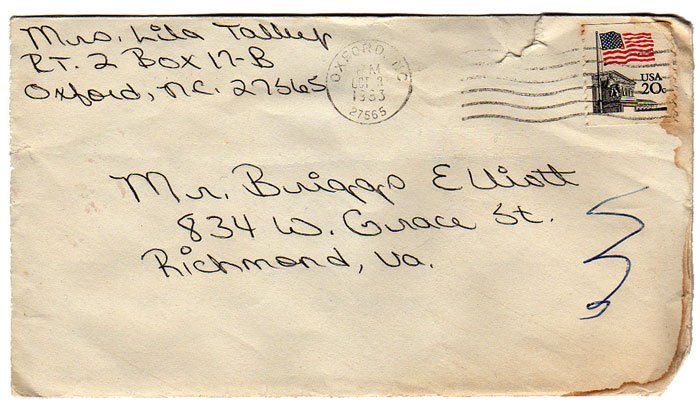
I also found this letter...
It's odd how something from only 23 years ago looks so old- it makes you realize how everything around you, everything you consider current, will in very little time become a nostalgia evoking tchotchke for the next generation.
Bring on the trash of Spring!
There were a lot of magazines from the late seventies and early eighties, a few lampshades, a pair of brown leather shoes, a couple bags of screws, and a small box that contained what I imagine were the contents of some recently deceased person's desk drawer (the "main"drawer where pens, paper clips, stamps and a calculator are kept).
This is great because the person (Kim and I think a woman) retrofitted a free calendar with letter tabs to make their own address book.
There were two photographs in the little box. There's this one of a guy in what looks like a church basement (or maybe he owned a restaurant- or maybe this is the kitchen at the old Gandalf's?).
Then there's this one of a couple cutting their wedding cake. Charles and I both thought it looked like they got married at Bryant Park- near the playing fields (but more importantly, near the Meadow). Without a doubt the bridesmaid takes the cake- click on her to get a better look. I've found quite a few wedding pictures, maybe during June I'll do a special found wedding album.
This postcard was also in the box- it is beautiful, reminds me of some of my favorite postcards of hotel dining rooms, and of course I'll never look at a vacuum cleaner the same way now that I've seen Judy's work.
I also found this letter...
It's odd how something from only 23 years ago looks so old- it makes you realize how everything around you, everything you consider current, will in very little time become a nostalgia evoking tchotchke for the next generation.Bring on the trash of Spring!
Monday, April 03, 2006
Art Schlep
I went to NYC, Philadelphia and DC last week to pick up Judith Schaecter's work for an exhibit (along w/ VCU prof Jack Wax) that opens at the Visual Arts Center Friday. I made it to MOMA in time to see an excellent pairing of circa 1960's Winogrand and 1990's DeCorcia, the Munch show (I'm sorry but I hear the Smashing Pumpkins when I look at his work- it's so over the top dramatique!), and the exhibit of New Spanish Architecture. The architecture exhibit topped my list for this visit, and while I walked to the subway station below the Citigroup building I wondered how a person ever reigns in their ego after having had a hand in building something so huge- altering such a large part of the world.
MOMA's collection of photography is, needless to say, excellent... and thanks in large part to the much loathed John Szarkowski. Adjacent to the selection of photographs from the museum's permanent collection was a show of Szarkowski's work- straight, black and white, large format, exquisitely printed, modestly sized, prints of barns, farm implements, apple trees, and orchards from upstate New York. Hurrying through his work (and wondering whether I'll one day get to a point where I understand his and Frielander's fascination with photographing brambles in black and white) I thought about how little respect I afforded his images even though just moments before I was staring into the eyes of an Arbus print which, without Szarkowski, I most likely would have never seen.
Sunday, April 02, 2006
Byrd Park Find!


Paul and I were walking (and yacking) our way through Byrd Park this afternoon and I mentioned to him that I hadn't found a picture in almost a month, and that I was beginning to worry. About 30 minutes later I found these.
Wednesday, March 29, 2006
Sister My Sister

Kim and I went to my folks' house last weekend for a day of eating, drinking, laughing and snapping with my parents, my sister Donna, Nana, my mom's sister Donna, my cousins Lisa and Fred. All activity at my parents' house happens around the kitchen table despite my mom's continued attempts to have us go downstairs where there is much more room.
Early in the day Donna (my sister- a well off, well traveled 30 something with a boyfriend in Iraq), in response to something that Donna (my Aunt) had said about the gathering that was taking place, said that my parents' kitchen was her favorite place in the entire world.
Wednesday, March 22, 2006
So Long, Naomi
Naomi Edsall, a former neighbor of mine (and Todd's) when I lived on Main Street in Frostburg died on March 10th. Naomi was one of my reasons for wanting to live at 195 East Main (the other being a desire to live as far from the previous six years of my life): she was chatty and welcoming when I asked her about the (phone number-less) FOR RENT sign in the upstairs window; her apartment (which she invited me into so she could write down the phone number of the landlord) smelled like beef stew- or at least that's how I remember it- (it seemed like her apartment always smelled like beef stew) and I'll never forget the two mason jars full of the stuff she gave me during the year that we were neighbors (also the year I started eating meat again). I loved that stew. One of the other benefits of being her neighbor was that she was nearly deaf- I could play my accordion at any hour and not bother her.
Naomi quickly became my Nana away from my Nana- when I was headed to the store I’d call and ask if she needed anything. On occasion Annabelle and I would go downstairs where I’d play tunes for her and listen to her stories about her oodles of brothers and sisters (all but one of nine dead), her having grown up on a farm in Avilton, Maryland, singing with her sisters in church, the Tallyho! (the restaurant she and her husband owned), her pet Pomeranian that died of cancer, Lawrence Welk and Myron Floren, the pain of missing her sister Vera (whom she had lived with), and her laments for her mother who she swore never wanted to have so many children.
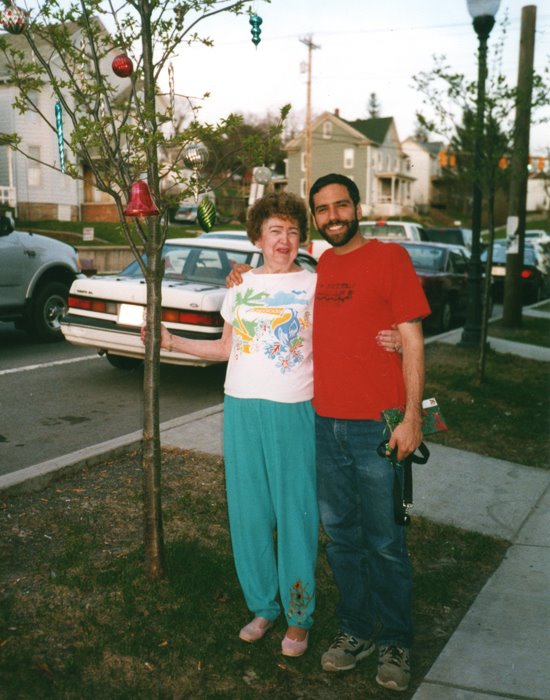
When it snowed Todd and I would shovel her sidewalk, clean off her car, and occasionally we’d remove the fallen twigs from the low roof behind her kitchen. One icy February night, on the way home from either Kim's house, or the bar, I found a box of Christmas decorations (intended for the trash but blown into the street) and decided to decorate the small, sad, leafless, and neutered pear tree in the small bit of grass between our front doors and the road. I went to bed nervous as to how Naomi might react to the decorations- would she think I was silly? That this wasn’t the kind of thing a man did- even if he did play the accordion? At first she thought I was ridiculous for doing it-- in her only-her voice she asked me why I’d done it. But by mid March I got a call telling me that a decoration had blown off and would I come down and put it back up? I went downstairs and asked her which limb she wanted it on- when she had decided, I twisted the used baggie-tie that she had affixed to the decoration onto the limb and we looked at the tree for a little while and had a chat.
Naomi couldn’t understand why I wanted to leave my job teaching at FSU and was sure that I’d return from Virginia after getting my degree. Last summer I even received an angry letter from her telling me how disappointed she was in my having decided to stay in Richmond instead of coming back to the place where people loved me.
From The Republican News:
NAOMI A. EDSALL
Naomi A. (Chaney) Edsall, 88, Frostburg, died Fri-day, March 10, 2006, at St. Vincent de Paul Nursing Center.
Born July 1, 1917, in Avilton, she was a daughter of the late Walter Chaney and Alice (Whiteman) Chaney. She was also preceded in death by her husband, William Edsall; five sisters, Vera Chaney, Hazel Robertson, Violet Chaney, Marie Bennett, and Ruth Crowe; and four brothers, Edgar, Oscar, Lawrence, and Paul Chaney.
She was a graduate of Grantsville High School. She retired as a housekeeper at Frostburg State University. She was a member of the Frostburg Church of the Brethren, where she served in the Women's Fellowship, sang in the choir, and formerly served on the church board. She was also a member of the Women of the Moose 348.
Surviving are one brother, the Rev. Connell Chaney, Grantsville; numerous nieces and nephews; and two stepsons, Richard and Robert Edsall, both of Johnstown, Pa.
Friends were received at the Durst Funeral Home, Frostburg, where a service was held on Tuesday, March 14, with the Rev. Rick Riley officiating.
Interment was in the Sunset Memorial Park.
In lieu of flowers, the family requests that memorials be directed to the Frostburg Church of the Brethren, 1 Beall St., Frostburg, MD 21532.
Subscribe to:
Posts (Atom)